

TL;DR:
- Catering marketing is a strategic system that attracts, converts, and retains clients for catering services. It relies on brand consistency, digital presence, persuasive food photography, targeted outreach, and strong follow-up systems.
Catering marketing is the strategic system restaurants use to attract, convert, and retain clients for their catering services. It combines brand identity, digital presence, professional food photography, targeted outreach, and follow-up systems into a single revenue-generating funnel. The U.S. catering services market is valued at $77 billion in 2026, growing at 6.2% annually. That growth is driven largely by corporate events, which means the opportunity for your restaurant is real and expanding. Most operators treat catering promotion as a series of disconnected tasks. The ones who win build a system.
What is catering marketing and why does it matter?
Catering marketing is defined as the full set of strategies a restaurant uses to make its catering services visible, credible, and easy to book. It is not the same as your dine-in marketing. Catering is a high-trust, high-ticket purchase with a longer decision cycle. A corporate client booking lunch for 200 people is not making an impulse decision. They are researching, comparing, and looking for proof that you can deliver.
The funnel-based approach is what separates growing catering operations from stagnant ones. Successful caterers build a system that moves strangers through awareness, consideration, and conversion, then keeps them coming back. Every tool you use, from your Google Business Profile to your Instagram feed to your follow-up emails, should serve a specific stage in that funnel.
The importance of catering marketing also comes down to revenue concentration. A single corporate catering contract can be worth more than a week of dine-in covers. Losing that client to a competitor who responded faster or had better photos is an expensive mistake. Building a proper marketing system protects that revenue and compounds it over time.
What are the essential components of an effective catering marketing system?
A catering marketing system has four layers: brand identity, digital presence, outreach, and retention. Each layer feeds the next.
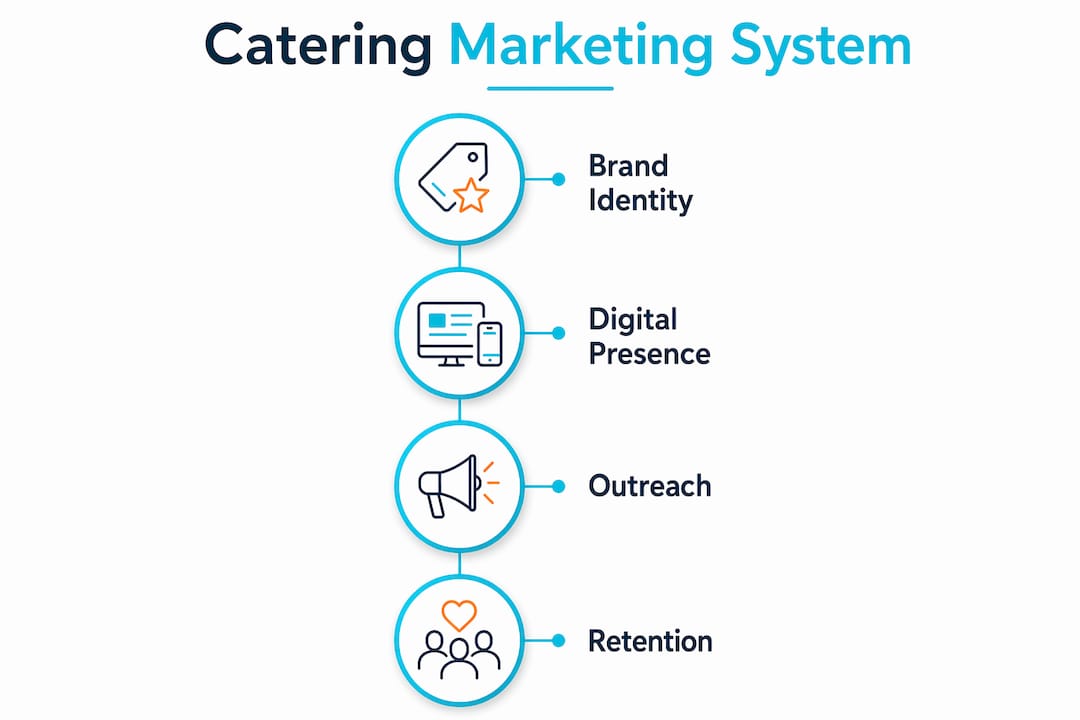
Brand identity as your foundation
Your brand is the first thing a potential catering client judges. That means a consistent logo, color palette, tone of voice, and visual style across every touchpoint. Your catering menu, your website, your proposals, and your social media should all look like they belong to the same business. Inconsistency signals disorganization, and no one hires a disorganized caterer for their company’s annual gala.

Digital presence: where clients find you
Your website is your most important catering asset. It needs a dedicated catering page with clear pricing tiers, a sample menu, a photo gallery, and a simple inquiry form. Beyond your site, your Google Business Profile is how local clients discover you. Optimize it with your catering services listed, recent photos uploaded, and reviews actively collected. Local SEO, meaning showing up when someone searches “corporate catering near me,” is free traffic that converts at a high rate.
Outreach tactics that fill your calendar
Once your digital presence is solid, you push traffic toward it through outreach:
- Email campaigns to past clients, local businesses, and event planners
- Social media with scroll-stopping food photos and behind-the-scenes event clips
- Google Ads and Meta Ads targeting local decision-makers searching for catering
- Partnerships with event venues, wedding planners, and corporate offices
You can explore digital ad strategies that are built specifically for catering and private event bookings.
Pro Tip: Set up an automated email or text response for every catering inquiry. 80% of catering inquiries go to the vendor who responds first. Automation means you never lose a lead to a slow reply.
How does high-quality food photography impact catering marketing success?
Professional food photography is the single most important marketing asset in your catering toolkit. Catering clients cannot taste your food before they book. They rely entirely on visuals to judge your capability and quality. A blurry phone photo of a buffet table tells them nothing good.
The numbers back this up. Restaurant catering menus using high-quality food photography see a 20–45% increase in sales. Delivery app listings with images generate up to 70% more orders. That is not a marginal difference. It is the difference between a calendar that fills and one that sits empty.
Your photo library should cover every catering format you offer: corporate box lunches, cocktail receptions, plated dinners, buffet spreads, and dessert stations. Use those images everywhere: your website catering page, your proposals, your Google Business Profile, your Instagram grid, and your email campaigns. Consistency across channels builds the visual trust that converts inquiries into signed contracts.
For a deeper look at how photography drives revenue, Ionhospitality covers food photography’s impact on restaurant marketing in detail.
Pro Tip: Treat your photo library as a core business asset, not a one-time expense. Schedule a professional shoot every six months to keep your visuals current and seasonal.
What digital marketing strategies drive more catering bookings?
Digital marketing for catering works best when you run multiple channels in coordination. No single channel does the full job. Here is how the major options stack up:
| Channel | Best for | Key advantage | Watch out for |
|---|---|---|---|
| Google Ads (PPC) | High-intent local searches | 5:1 revenue return on ad spend | Requires ongoing budget management |
| Meta Ads (Facebook/Instagram) | Brand awareness and retargeting | Visual format suits food well | Lower purchase intent than search |
| Local SEO | Organic discovery | Free traffic, high trust | Takes 3–6 months to build |
| Email marketing | Retention and repeat bookings | Direct, personal, low cost | Requires a quality contact list |
| Social media (organic) | Portfolio and engagement | Builds long-term brand credibility | Visual consistency is critical |
Data-driven marketing has a statistically significant relationship with catering business performance. That means you need to track which channels are converting inquiries into paid events, not just which ones generate clicks or followers.
The most effective catering advertising technique is combining Google Ads for capturing active searchers with Meta retargeting for warming up people who visited your site but did not inquire. This two-step approach covers both ends of the decision cycle. You can build this out with a restaurant owner’s guide to digital advertising and bookings.
How to turn one-time catering clients into repeat customers?
Retention is where catering marketing pays its biggest dividends. A client who books once and returns three times per year is worth far more than three separate one-time clients. The cost to retain is a fraction of the cost to acquire.
Here is a structured retention process that works:
- Send a post-event follow-up within 48 hours. Thank the client, ask for feedback, and include a direct link to leave a Google review. This captures social proof while the experience is fresh.
- Add them to a dedicated catering email list. Send quarterly updates with seasonal menu changes, new offerings, and early-access booking windows for peak periods.
- Make re-booking frictionless. Use a direct online ordering platform so repeat clients can reorder their standard package without going through a full sales conversation.
- Build a referral program. Offer a discount or complimentary add-on for every new client a past client refers. Referrals are the top booking channel for caterers, with 89.7% ranking them as their highest-value source.
- Personalize your outreach. Reference their last event. Mention that their annual holiday party is coming up. Clients notice when you remember them, and it builds loyalty that no competitor can easily undercut.
For more on building repeat customer systems that apply directly to catering, Ionhospitality has a full breakdown worth reading.
Pro Tip: Create a simple CRM spreadsheet or use a tool like HubSpot to track every catering client’s event date, headcount, and menu choices. That data makes your follow-up feel personal, not generic.
Key Takeaways
Catering marketing works when it operates as a connected system, not a collection of random tasks, combining brand identity, photography, digital channels, and retention into one revenue-generating funnel.
| Point | Details |
|---|---|
| Define your catering funnel | Build a system that moves prospects from discovery to booking to repeat business. |
| Invest in food photography | High-quality images drive a 20–45% sales increase and are your primary trust signal. |
| Run coordinated digital channels | Combine Google Ads, Meta Ads, local SEO, and email for full-funnel coverage. |
| Respond to inquiries immediately | 80% of catering bookings go to the first vendor who replies. Automate your response. |
| Build a retention process | Post-event follow-ups, referral programs, and easy re-booking multiply client lifetime value. |
Why most catering marketing fails (and what actually works)
I have worked with enough restaurant owners to spot the pattern immediately. They put together a catering menu, add a page to their website, and then wonder why the phone is not ringing. The problem is not the food. The problem is that catering marketing was treated as a one-time setup rather than an ongoing system.
The most common mistake I see is neglecting follow-up. A restaurant will run a great event, the client is happy, and then nothing happens. No thank-you email. No review request. No check-in before the next holiday season. That client books somewhere else the following year, not because they were unhappy, but because someone else stayed in front of them.
The second mistake is underinvesting in photography. I have seen restaurants spend thousands on a new catering menu and then photograph it on a smartphone. The food might be extraordinary, but the photos say otherwise. Your visuals are your first impression in every digital channel, and first impressions in catering are permanent.
What actually works is treating catering marketing the same way you treat your kitchen: with systems, standards, and consistent execution. Track your inquiry sources. Measure your conversion rate from inquiry to booked event. Test your email subject lines. Review your Google Ads performance monthly. The restaurants that grow their catering revenue year over year are the ones making decisions based on data, not gut feeling.
Brand consistency matters more in catering than in dine-in, because the decision cycle is longer. A corporate event planner might see your Instagram post in January, visit your website in March, and book in April. Every touchpoint in that journey needs to reinforce the same message: you are professional, reliable, and worth the investment.
— Doug
How Ionhospitality helps restaurants grow catering sales
If you are ready to stop leaving catering revenue on the table, Ionhospitality builds the marketing systems that fill your calendar with private events and catering bookings.
Ionhospitality is a social media marketing and advertising agency built exclusively for restaurants. We handle your social media advertising, create scroll-stopping content, and run targeted ad campaigns that put your catering services in front of the right clients at the right time. No commissions. No guesswork. Just a system designed to get you more bookings. Check out our catering sales tips or book a discovery call to talk through a strategy built for your restaurant.
FAQ
What is catering marketing in simple terms?
Catering marketing is the system a restaurant uses to attract, convert, and retain clients for its catering services. It includes digital presence, food photography, outreach, and follow-up.
How is catering marketing different from regular restaurant marketing?
Catering involves a longer decision cycle and higher transaction values than dine-in. It requires a dedicated funnel with trust-building visuals, direct outreach, and structured follow-up rather than foot-traffic tactics.
What is the most effective digital channel for catering promotion?
Google Ads delivers a 5:1 revenue return for catering businesses and captures high-intent local searches. Pairing it with Meta retargeting covers the full decision cycle.
How important is food photography for catering marketing?
Professional photography is the most critical catering marketing asset. Menus with quality images see a 20–45% sales increase, and delivery listings with photos generate up to 70% more orders.
How do I get more repeat catering clients?
Send a follow-up email within 48 hours of every event, request a Google review, and add clients to a dedicated email list. Referrals drive 89.7% of top catering bookings, so build a formal referral program into your process.

Add a Comment