
TL;DR:
- Restaurant owners often underestimate untapped marketing opportunities that can increase bookings. Strategic marketing focused on measuring results boosts reservations, private event bookings, and guest loyalty. Concentrating on targeted channels like social media, Google My Business, and email, along with monitoring key metrics, drives consistent growth.
Most restaurant owners think a packed Friday night means their marketing is working. But here’s the uncomfortable truth: even busy restaurants leave thousands of dollars in potential bookings untapped every single week. The tables sitting empty on Tuesday afternoons, the private dining room that rarely gets reserved, the regulars who never heard about your new seasonal menu — these are all marketing gaps. This guide breaks down exactly how strategic marketing drives more reservations, fills your private event space, and keeps your restaurant ahead of the competition. Whether you’re starting from scratch or looking to sharpen what you already do, these strategies are built for real restaurant owners who want real results.
Table of Contents
- The connection between marketing and increased restaurant bookings
- Essential marketing channels for boosting everyday bookings
- How event and private booking marketing strategies fill your room
- Refining your strategy: Monitoring, measuring, and optimizing bookings
- Our take: What most restaurant marketing advice overlooks
- Ready to fill more tables? Next steps with ION Hospitality
- Frequently asked questions
Key Takeaways
| Point | Details |
|---|---|
| Marketing fills more tables | Strategic marketing is directly linked to higher booking rates for dining and events. |
| Channels matter most | Social media, email, and content marketing are proven to drive both quick and sustained reservation increases. |
| Track what works | Regularly monitor which marketing activities truly boost your bookings so you can double down on winners. |
| Events amplify results | Effective event marketing can add 30% or more to your revenue by better utilizing your restaurant’s space. |
| Continuous improvement | Small tweaks to offers, messaging, and monitoring make a big difference over time. |
The connection between marketing and increased restaurant bookings
Marketing isn’t just about visibility. It’s about creating demand and turning that demand into actual reservations. When done right, it works like a flywheel — each campaign builds on the last, compounding your results over time.
Here’s how the mechanics work. A well-targeted ad reaches a local diner who’s never heard of you. They click, they see your menu and photos, they book a table. That same diner comes back, brings friends, and leaves a review. Now your restaurant shows up higher in local search results, which drives even more bookings. That’s the compounding effect of monitoring online trends and staying active across channels.
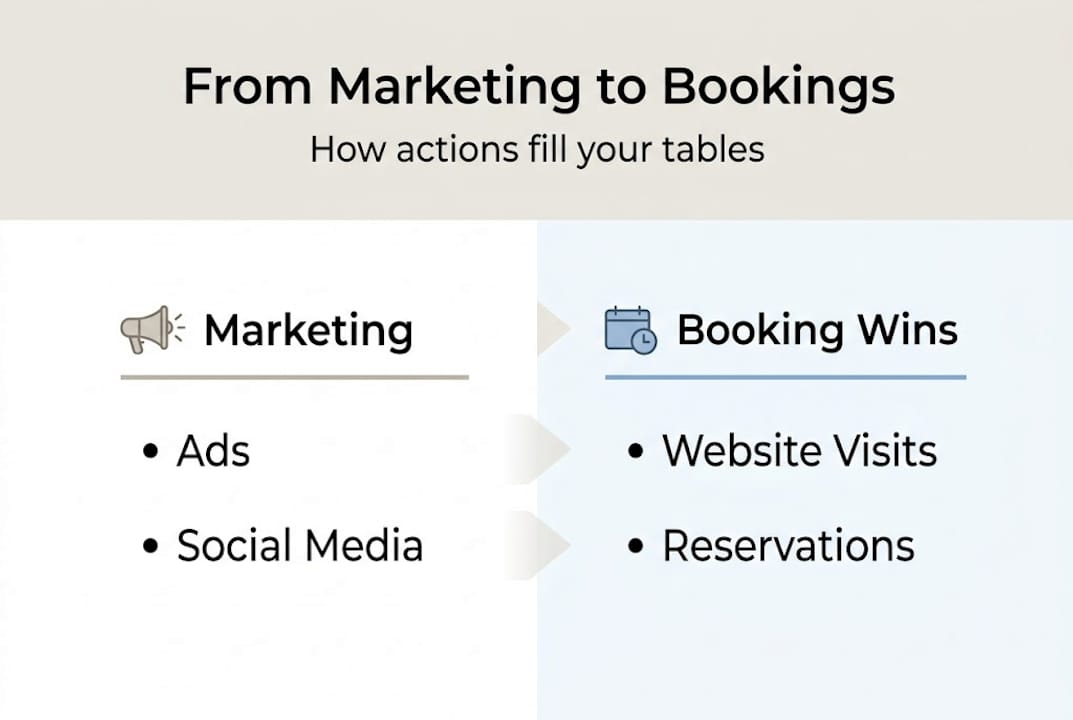
Restaurants that invest in marketing see a significant increase in table bookings, especially during off-peak hours. That’s not a coincidence. Targeted campaigns can push promotions during slow periods, turning a dead Tuesday into a revenue-generating night.
When you’re focused on attracting new customers, it’s critical to track the right numbers. Don’t just count likes and shares. Watch these key metrics:
| Metric | What it measures | Why it matters |
|---|---|---|
| Conversion rate | Visitors who book a table | Shows if your message is landing |
| Reservation volume | Total bookings per week/month | Tracks overall growth |
| Event booking rate | Private/group bookings secured | Measures high-value revenue |
| Cost per booking | Ad spend divided by bookings | Tells you what’s profitable |
| Return visit rate | Repeat customers booking again | Signals loyalty and satisfaction |
“Marketing without tracking is just guessing. The restaurants winning right now are the ones treating every campaign like a science experiment — testing, measuring, and doubling down on what works.”
The restaurant growth insights are clear: restaurants that actively market themselves don’t just get more customers. They get better customers — ones who book ahead, spend more per visit, and refer others. That’s the real ROI of a strong marketing strategy.
Essential marketing channels for boosting everyday bookings
Not every channel is worth your time. The goal is to focus your energy where your ideal guests are already spending theirs. Here’s a breakdown of what actually moves the needle for everyday dining reservations.
Social media advertising is one of the fastest ways to reach local diners. Platforms like Instagram and Facebook let you target by zip code, age, interests, and dining behavior. A well-crafted reel showing your signature dish at peak sizzle can stop someone mid-scroll and push them to book that same night. Pair that with social media campaigns built around your best offers and you have a direct line to new guests.
Google My Business is non-negotiable. When someone searches “restaurants near me,” your profile is often the first thing they see. Keep your hours updated, respond to reviews, and post photos regularly. A strong profile with recent reviews converts searchers into diners faster than almost any other channel.
Email marketing gives you direct access to guests who already like you. A well-timed email about a new menu item or a limited-time offer can drive bookings within hours. It’s low-cost and high-return when done consistently.
Content creation and SEO are your long-game plays. Content creation for restaurants and regular posting drive up to 40% more bookings. That’s a massive lift from simply showing up consistently online.
Here’s a quick comparison to help you prioritize:
| Channel | Speed of results | Cost | Best for |
|---|---|---|---|
| Social media ads | Fast (days) | Medium | New customer acquisition |
| Google My Business | Medium (weeks) | Free | Local search visibility |
| Email marketing | Fast (hours) | Low | Repeat bookings |
| SEO/Content | Slow (months) | Low to medium | Long-term organic traffic |
🔑 Key channels to activate:
- Instagram and Facebook ads targeting your local area
- Google My Business with fresh photos and reviews
- A monthly email newsletter with offers
- Blog content and local SEO for organic reach
- Boosting brand awareness through consistent visual storytelling
Pro Tip: Don’t try to be everywhere at once. Pick two or three channels where your guests are most active and go deep before spreading out.
How event and private booking marketing strategies fill your room
Private events are one of the highest-margin revenue streams a restaurant can have. A booked private dining room on a slow Monday night can outperform a full floor on a busy Friday. But most restaurants treat event marketing as an afterthought. That’s a huge missed opportunity.
Start by identifying the types of events your space can host:
- Corporate meetings and team dinners — businesses book regularly and often have larger budgets
- Birthday and anniversary celebrations — emotional occasions where guests want a memorable experience
- Community gatherings and nonprofit events — great for building local relationships and visibility
- Holiday parties and seasonal celebrations — high demand, book weeks or months in advance
- Rehearsal dinners and milestone events — loyal, high-spend guests who refer others
Once you know your event types, build marketing around them. Targeted ads work especially well here. A Facebook ad aimed at local event planners or HR managers can fill your calendar for months. Themed offers, like a “Holiday Party Package” with a set menu and included decorations, remove friction and make it easy to say yes.
Partnerships with local organizations, wedding planners, or corporate event coordinators can also drive consistent referrals. These relationships compound over time, just like your other marketing efforts.
📊 Revenue impact: Marketing special events and themed nights can increase overall revenue by up to 30%. That’s not a small number. For a restaurant doing $500K annually, that’s $150K in additional revenue from a focused event marketing strategies approach.
Make the booking process frictionless. Use an event organization guide as a model for how to present your event options clearly. A simple online inquiry form, a clear menu package, and a fast response time can be the difference between a booking and a lost lead.
Pro Tip: Add a clear “Book a Private Event” button to your website’s homepage and Instagram bio. If guests have to dig to find it, they won’t bother.
Refining your strategy: Monitoring, measuring, and optimizing bookings
Getting your marketing live is just the beginning. The restaurants that consistently grow their bookings are the ones that treat their strategy like a living system — always testing, always improving.
Start by setting clear booking KPIs (key performance indicators). These are the numbers you check every week to know if your marketing is working. Examples include total reservations, private event inquiries, email open rates, and cost per booking.
Here’s what to monitor consistently:
- Reservation platform analytics — most tools like OpenTable or Resy show booking trends by day, time, and source
- Google Analytics — track which pages drive the most reservation clicks
- Social media insights — measure which posts lead to profile visits and link clicks
- Email metrics — open rates, click rates, and how many emails led to a booking
- Review site activity — new reviews and your average star rating signal guest satisfaction
Analysis of marketing data helps identify which channels yield the most booked tables. That means you stop wasting money on what doesn’t work and double down on what does.
A/B testing is one of the most underused tools in restaurant marketing. Try two versions of an email subject line and see which gets more opens. Test two different ad images and see which drives more clicks. Even small changes can produce outsized results.
Schedule a monthly strategy review. Look at your numbers, compare them to the previous month, and ask: what worked, what didn’t, and what should we try next? This habit alone separates growing restaurants from stagnant ones.
For deeper insights, explore niche marketing strategies and how monitoring trends can surface new opportunities before your competitors spot them.
Pro Tip: Even a 10% improvement in your email open rate or ad click-through rate can translate directly into dozens of additional bookings each month. Small tweaks add up fast.
Our take: What most restaurant marketing advice overlooks
Here’s something most marketing articles won’t tell you: reach is overrated. Getting 10,000 impressions on an ad means nothing if zero people click the booking link. Yet most restaurant owners measure success by how many likes their posts get. That’s the wrong scoreboard.
The restaurants we see winning consistently are obsessed with conversion, not just attention. They track every step from ad view to confirmed reservation. They follow up on event inquiries within the hour. They use their booking system as a marketing tool, not just a scheduling tool.
The hospitality marketing evolution has shifted toward full-funnel thinking. That means your marketing doesn’t stop when someone sees your ad. It continues through the booking confirmation, the pre-visit reminder, and the post-visit follow-up asking for a review.
Guest experience is marketing. Every touchpoint either builds loyalty or erodes it. The restaurants that understand this don’t just get more bookings — they get better ones, from guests who come back and bring others.
Ready to fill more tables? Next steps with ION Hospitality
You now have a clear picture of how strategic marketing drives bookings — from everyday reservations to packed private events. The question is: who’s going to execute it?
At ION Hospitality, we specialize in social media advertising services built specifically for restaurants. We handle everything from scroll-stopping content to targeted ad campaigns, all with 0% commissions. Whether you want to explore our social media campaigns guide or you’re ready to talk strategy, we’re here to help. Take the first step and book a discovery call today. Let’s turn your marketing into a booking machine. 🚀
Frequently asked questions
Which marketing channel gives the fastest boost to restaurant bookings?
Social media campaigns are highly effective for rapid booking increases, especially when tied to timely offers or upcoming events. Paid social ads can generate reservations within hours of going live.
How can I track if my marketing is really increasing bookings?
Set clear booking KPIs and use analytics and data tracking from your reservation tools to measure each campaign’s performance. Compare week-over-week and month-over-month to spot what’s actually working.
What’s the best way to market private events at my restaurant?
Targeted event ads, local partnerships, and a simple online reservation form are the most effective combination. Event marketing that leads to up to 30% revenue increases starts with making the booking process as easy as possible.
Do I need to hire an agency or can I do this in-house?
Many tools are DIY-friendly, but an agency can accelerate results significantly by bringing both strategy and hands-on execution experience. If your time is better spent running your restaurant, delegation often pays for itself.

Add a Comment