

TL;DR:
- 85% of customers discover restaurants online via Google and social media channels.
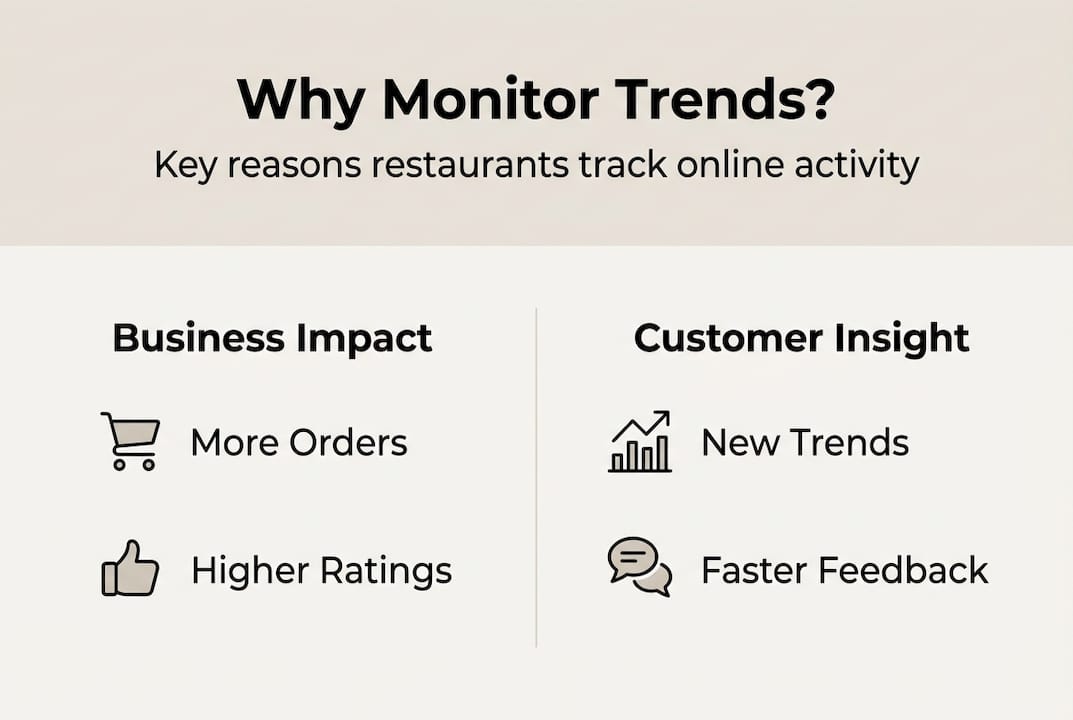
- Monitoring digital signals helps restaurants boost visibility, engagement, and early trend adoption.
- Combining trend data with consistent quality maintains long-term success and customer loyalty.
85% of customers now discover restaurants online, and if you’re not tracking what they’re searching for, talking about, and ordering, you’re leaving real money on the table. Traditional advertising like flyers, print ads, and word-of-mouth alone simply can’t keep up with how fast consumer behavior shifts today. The restaurants winning right now are the ones watching digital signals closely and acting fast. In this guide, we break down why online trend monitoring is your sharpest marketing tool, how to use it practically, and what kind of results you can actually expect when you commit to a data-driven approach.
Table of Contents
- The shift: Why digital monitoring is critical for modern restaurants
- Trend adoption: How restaurants leverage online data to adapt and innovate
- The ROI: Real-world outcomes from trend monitoring and digital engagement
- Integration: Turning trend insights into action for marketing and menu success
- Expert perspective: Balancing viral trends with lasting quality
- Unlock your restaurant’s growth with expert digital marketing
- Frequently asked questions
Key Takeaways
| Point | Details |
|---|---|
| Maximize online visibility | Monitoring trends ensures your restaurant appears where customers search and discover. |
| Adapt menu and marketing fast | Real-time insights help you quickly introduce viral items and optimize promotions. |
| Engage reviews for revenue | Proactive review monitoring and quick responses can raise ratings and boost sales. |
| Integrate digital and in-person data | Combine online monitoring with POS and surveys to understand all guest segments. |
| Balance innovation with quality | Embrace trends without sacrificing core food or service standards for lasting success. |
The shift: Why digital monitoring is critical for modern restaurants
Customers don’t flip through the Yellow Pages anymore. They pull out their phones, search Google, scroll Instagram, and check Yelp reviews before they ever walk through your door. This isn’t a trend. It’s the new baseline. And if your restaurant isn’t showing up where people are looking, your competitors are getting those tables.
According to the 2026 Restaurant Trends Report, 85% of consumers search for restaurants on Google and 74% use social media for discovery. That’s an enormous share of potential customers making decisions before they ever taste your food.
Here’s a quick look at how customers are finding restaurants today:
| Discovery channel | % of consumers using it |
|---|---|
| Google Search | 85% |
| Social media (Instagram, Facebook) | 74% |
| Yelp | 53% |
| Word of mouth | 41% |
When you monitor these channels actively, you gain a real-time pulse on what customers want. That’s the edge. Here’s what consistent digital monitoring delivers:
- 🔍 Visibility boost: You know which keywords, hashtags, and topics are driving traffic, so you can boost restaurant brand awareness where it counts.
- 💬 Deeper engagement: You respond to reviews, join conversations, and build loyalty before a competitor even notices.
- 🎯 Smarter targeting: You understand who your audience is and what they’re craving, making your social media campaigns for growth far more effective.
- 📈 Revenue signals: You catch emerging demand early, whether it’s a new dietary preference or a viral dish, and capitalize before the window closes.
“Prioritize Google/Yelp monitoring (85% search), AI tools for scale, and personalized marketing (81% increasing activity) to boost engagement and sales amid economic pressures.”
The bottom line? Monitoring is no longer optional. It’s how modern restaurants stay visible, relevant, and ahead of the curve. Pair it with strong social media advertising and you’ve got a system that works around the clock.
Trend adoption: How restaurants leverage online data to adapt and innovate
Knowing you should monitor trends is one thing. Knowing how to do it efficiently is another. Let’s break down the mechanics.
Restaurants today use a mix of manual and automated tools to track what’s happening online. Manual monitoring means you or your team check Google reviews, scroll social feeds, and read competitor menus. It works, but it’s slow and easy to miss things. Automated tools use AI to do the heavy lifting, scanning thousands of data points in real time.
| Feature | Manual monitoring | AI-driven tools |
|---|---|---|
| Speed | Slow (hours/days) | Real-time |
| Scale | Limited | Unlimited |
| Accuracy | Human error risk | High consistency |
| Cost | Low (time-heavy) | Low to moderate |
| Ease of use | Familiar | Requires setup |
AI sentiment analysis and social listening tools like review aggregation dashboards, automated alerts, and web scraping for competitor menus give you a complete picture fast.
Once you have the data, here’s how to act on it:
- Monitor — Track Google, Yelp, Instagram, and TikTok daily for mentions, trending dishes, and competitor activity.
- Test — Introduce a small-batch version of a trending item before committing to a full menu rollout.
- Refine — Gather feedback from guests and reviews. Adjust the recipe, presentation, or price point.
- Launch — Roll it out with a targeted social push and track engagement closely.
Gen Z is a massive driver of this cycle. 84% of Gen Z try social media food trends, which means a viral dish on TikTok can translate directly into foot traffic if you move quickly. Think birria tacos, smash burgers, or specialty coffee drinks. Restaurants that spotted these early and adapted their menus saw faster revenue growth and higher social engagement.
Your content creation strategies should reflect what’s trending too. Pairing a new menu item launch with a scroll-stopping reel amplifies reach dramatically. Even in categories like coffee service, staying current with trending flavors and formats drives measurable profit.
Pro Tip: Balance innovation with execution. A trendy dish that arrives cold or inconsistently plated will hurt you more than help. Quality beats novelty every time in the review section.
The ROI: Real-world outcomes from trend monitoring and digital engagement
Let’s talk results. Because monitoring trends isn’t just a marketing exercise. It directly impacts your bottom line.
Online reviews are one of the most powerful revenue levers you have. 35% of guests say reviews heavily influence their dining decisions, and a single one-star increase on Yelp can boost revenue by 5 to 9%. That’s not a rounding error. That’s real money.
Here’s what the data looks like before and after restaurants implement active monitoring:
| Metric | Before monitoring | After monitoring |
|---|---|---|
| Average star rating | 3.7 | 4.2 |
| Online order volume | Baseline | +80% |
| Review response rate | 30% | 68% |
| Social engagement rate | Low | Significantly higher |
Those numbers come from real restaurant case studies where active web scraping, review monitoring, and menu optimization were applied consistently over time.
Here’s a simple framework to replicate those results:
- Monitor — Set up alerts for your restaurant name, competitors, and trending food keywords.
- Respond — Reply to every review, positive or negative, within 24 hours. 94% of U.S. restaurants now monitor reviews because the ROI is undeniable.
- Optimize — Use review feedback to refine dishes, fix service gaps, and update your menu descriptions.
- Promote — Take your best-reviewed items and feature them in targeted ads and organic posts.
- Measure — Track rating changes, order volume, and engagement monthly to confirm what’s working.
Restaurants that commit to this cycle consistently outperform those that don’t. Pair this with smart strategies for attracting new customers and marketing strategies for restaurants, and you’ve got a growth engine that compounds over time. Even operational upgrades like hospitality support services and coffee equipment improvements contribute to the overall guest experience that drives those ratings up.
Integration: Turning trend insights into action for marketing and menu success
Data without action is just noise. The real win comes from integrating what you learn into your daily operations and marketing decisions.
87% of operators now monitor reputation and social channels, which means the bar has been raised. Just watching isn’t enough anymore. You need a system for turning insights into moves.
Here’s how to make trend data actionable:
- 🍽️ Menu personalization: Use review data and trending searches to introduce dishes that match what your specific audience is already craving.
- 🕵️ Competitor analysis: Track what nearby restaurants are launching, promoting, and getting praised or criticized for. Then do it better.
- ⚡ Real-time marketing pivots: If a food trend blows up on a Tuesday, your content should reflect it by Thursday. Speed matters.
- 📊 Reputation management: Spot negative sentiment early and address it before it snowballs into a PR problem.
Pro Tip: Don’t rely on social data alone. Blend digital insights with your POS data and customer surveys for a fuller, more accurate picture of what’s actually driving sales versus what’s just getting likes.
One real challenge here is data overload. AI prioritization tools solve this by filtering the noise and surfacing only the signals that matter most for your restaurant. Set clear KPIs, like rating targets, response time goals, and engagement benchmarks, and let the tools work for you.
The practical cycle looks like this: monitor daily, synthesize weekly, test monthly, implement quarterly, and review impact every 90 days. This rhythm keeps you responsive without burning out your team.
Use strategies to attract customers informed by trend data, align them with your hospitality marketing evolution plan, and amplify with retargeting ads strategies to re-engage visitors who’ve already shown interest. Combine all of this with strong restaurant content creation and you have a complete system.
Expert perspective: Balancing viral trends with lasting quality
Here’s the honest truth that most marketing content won’t tell you: chasing every trend is a trap.
We’ve seen restaurants pivot their entire identity around a viral moment, only to confuse their regulars and dilute what made them special in the first place. Trends are a tool. They’re not a strategy.
“Execution consistency, including temperature, presentation, and service, often outweighs novelty in review outcomes. Viral appeal gets customers in the door. Quality keeps them coming back.”
Social media is powerful for reaching Gen Z and trend-forward diners, but over-reliance on social trends risks alienating older, non-digital customers who still represent a significant revenue base. The smart play is integration, not replacement.
Use trend data to test new ideas, but never let it override your core identity. Your best-selling dish, your signature cocktail, your weekend brunch, those are your anchors. Protect them. Improve them. Let trends add to your story, not rewrite it.
Want to go viral without losing your brand? Start with viral reels strategies that showcase what already makes you great. Even quality improvements in areas like coffee service can become content that drives business success when executed with intention.
Unlock your restaurant’s growth with expert digital marketing
You now have the framework. Monitoring trends, responding to reviews, adapting your menu, and integrating data into your marketing are all proven levers for growth. But knowing what to do and having the bandwidth to execute it consistently are two very different things.
That’s where ION Hospitality comes in. We specialize in social media advertising solutions built specifically for restaurants, helping you get more customers, book more private events, and grow online orders without the guesswork. From our brand awareness guide to proven social media campaigns, we’ve got the tools and expertise to turn your digital presence into a revenue machine. All done for you, with zero commissions. Ready to grow? Let’s talk. 🚀
Frequently asked questions
What are the main benefits of monitoring online trends for my restaurant?
Monitoring online trends gives you higher visibility, stronger customer engagement, and the ability to quickly adapt your menu and promotions. Restaurants that track trends consistently outperform those that rely on guesswork alone.
How can I avoid data overload when tracking online trends?
Use AI tools and smart dashboards to filter out noise and surface only the insights that matter most for your goals. AI prioritization makes trend monitoring manageable even for small teams.
Does social media really help attract more customers?
Absolutely. With 74% of customers discovering restaurants on social media, consistent and engaging posts directly expand your reach and drive more visits.
Is it necessary to monitor both reviews and social trends?
Yes, and most successful operators already do. 94% of U.S. restaurants monitor reviews and 87% track social channels because both feed into reputation and revenue.
How quickly should I respond to online reviews?
Aim to respond within 24 hours. 68% of operators who respond promptly see measurably higher ratings and stronger customer loyalty over time.
Recommended
- Boost Restaurant Brand Awareness: A Step-by-Step Guide
- Smart strategies to attract new restaurant customers in 2026
- 5 Proven Social Media Campaigns for Restaurant Growth
- How hospitality marketing evolved: strategies for restaurants
- Beyond the Bag: Why “Data-Driven Roasting” is Your Cafe’s Best Friend – https://trade.thecoffeefactory.co.uk

Add a Comment