
TL;DR:
- Most restaurant owners misconceive digital advertising as just social media posts and occasional Facebook ads. In reality, it encompasses email marketing, search engine marketing, display ads, mobile marketing, and targeting systems that reach the right customer at the right moment. Effective digital strategies focus on measurable outcomes like reservations and event inquiries rather than vanity metrics, requiring consistent optimization and targeted campaigns.
Most restaurant owners think digital advertising means posting on Instagram and maybe running a Facebook ad once in a while. That’s a fraction of the picture. Online advertising is actually an umbrella term that includes email marketing, search engine marketing, social media ads, display advertising, and mobile marketing, all powered by targeting systems that put your restaurant in front of the right person at exactly the right moment. If you’re leaving any of those channels untouched, you’re leaving tables empty and private event revenue on the floor. This guide breaks down what digital advertising really is and exactly how to use it to fill seats and book more events.
Table of Contents
- Defining digital advertising: More than just social
- How digital advertising works for restaurants
- Comparing digital channels: Which is right for your restaurant?
- Getting started with digital advertising: Steps for success
- What most owners get wrong about digital advertising
- Next steps: Put digital advertising to work for your restaurant
- Frequently asked questions
Key Takeaways
| Point | Details |
|---|---|
| Digital advertising explained | Digital advertising uses online platforms to reach potential diners and event clients with targeted, trackable messages. |
| Multiple powerful channels | Channels include social, search, email, display, and mobile—each with unique strengths for restaurants. |
| Target and measure results | Precise audience targeting and real-time measurement help restaurants refine campaigns for more bookings. |
| Most owners underuse it | Many restaurants only use social posts, missing out on advanced tactics like programmatic and retargeting for event bookings. |
| Start small, evolve fast | Beginning with simple campaigns and regular tracking leads to steady growth in guests and event reservations. |
Defining digital advertising: More than just social
Once you know digital advertising isn’t just about social posts, it helps to see how broad and powerful it truly is.
Think of digital advertising as the full toolkit, not a single tool. Digital advertising covers multiple tactics including search, social, email, display, mobile, and programmatic, all sharing the ability to target specific audiences and measure real results. Every channel operates differently, reaches a different kind of customer, and serves a different purpose in your marketing funnel.
Here’s a quick breakdown of the core channels:
- 🔍 Search ads (Google): Show up when someone types “best Italian restaurant near me” or “private dining room for 50 people.” High intent. People are actively looking.
- 📱 Social media ads (Facebook/Instagram): Reach diners and event planners based on interests, behaviors, location, and demographics. Great for visual storytelling.
- 📧 Email marketing: Nurture existing customers, announce events, and bring people back with targeted offers and invitations.
- 🖥️ Display ads: Banner and image ads shown across websites, apps, and news sites to build awareness and retarget website visitors.
- 📲 Mobile marketing: Ads delivered specifically to smartphone users, often tied to location. Perfect for reaching people near your restaurant.
- 🤖 Programmatic advertising: Automated ad buying that uses data to find and serve your ideal audience across multiple platforms simultaneously.
The game-changer: Traditional advertising (print, radio, TV) puts your message out and hopes the right person sees it. Digital advertising finds the right person and puts your message directly in front of them, then tells you exactly what happened next.
What makes digital advertising so powerful for restaurants is the combination of precise targeting and measurable outcomes. You’re not guessing. You’re tracking. The evolving restaurant marketing landscape means owners who understand these channels are pulling ahead of competitors who are still relying on word of mouth alone.
How digital advertising works for restaurants
With a basic understanding of the main channels, let’s see how digital advertising directly supports core restaurant goals.
Every restaurant has two main business objectives: get more people through the door for everyday dining, and book more private events. Digital advertising serves both, but the approach is different for each.
Targeting the right audience
The real power of digital ads is audience targeting. You can reach:
- Diners near you based on location radius (example: anyone within 5 miles of your restaurant)
- Corporate event planners based on job title, company size, or professional interests
- Past website visitors who looked at your private events page but didn’t submit an inquiry
- People who celebrated birthdays or anniversaries last year and are likely planning again
Retargeting in action 🎯
Programmatic advertising is the automated sale and delivery of digital ads via software, using ad servers and audience identifiers like cookies to serve ads to the right person. Here’s what that means practically: someone visits your website, browses your event packages, and leaves without booking. Retargeting catches them again, showing a tailored ad on Facebook, Instagram, or a news site they visit later, reminding them exactly why they were interested.
This is one of the highest-return strategies in restaurant marketing. The person already knows your brand. They just need a nudge.
How the funnel works for restaurants:
- Awareness: A display ad or social video introduces your restaurant to someone who’s never heard of you.
- Consideration: A retargeting ad shows your private event package to someone who visited your website.
- Conversion: A Google search ad captures someone actively looking to book a restaurant for a corporate dinner.
- Loyalty: An email campaign brings a past customer back for your next seasonal event.
| Restaurant goal | Best digital ad type | Why it works |
|---|---|---|
| Drive walk-in traffic | Search ads, social ads | High intent, local targeting |
| Book private events | Retargeting, social ads, email | Visual, specific, persuasive |
| Promote a new menu | Social video ads, email | Scroll-stopping creative |
| Increase online orders | Search ads, mobile ads | Captures immediate intent |
| Build brand awareness | Display ads, social ads | Wide reach, visual impact |
For launching campaigns for bookings, timing and creative are everything. A holiday party campaign that launches in November is already too late. Start in September. Run effective social ads with real photos of your event space, happy groups, and the food you’ll serve.
Pro Tip: Test at least two different ad creatives for every campaign. One focused on food visuals, one focused on the experience or occasion. Let the data tell you which one converts better, then scale the winner.
Comparing digital channels: Which is right for your restaurant?
Picking the right digital channel is critical, as each has strengths and trade-offs for different restaurant goals.
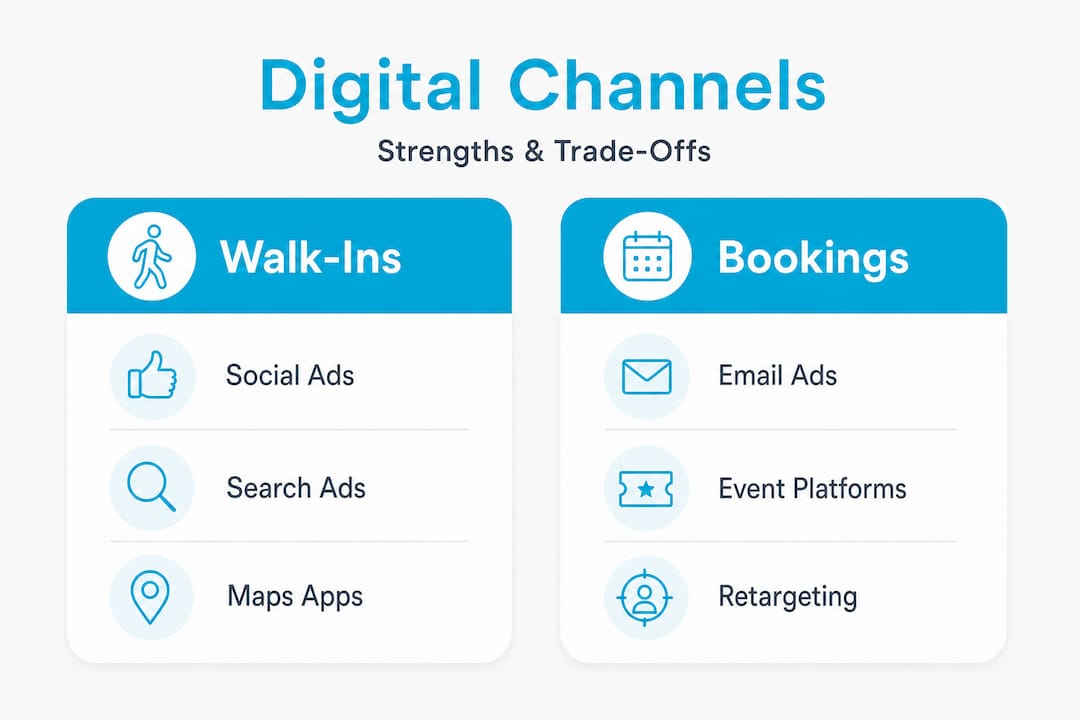
Not every channel makes sense for every goal. Online advertising includes search, social, email, display, and mobile, each with distinct advantages for targeting and measuring audiences. The key is matching the channel to what you’re actually trying to accomplish.
Channel comparison for restaurants:
| Channel | Best for | Targeting ability | Cost range | Time to results |
|---|---|---|---|---|
| Google search ads | Walk-ins, reservations, event inquiries | High intent keywords | Medium | Fast |
| Facebook/Instagram ads | Event bookings, awareness, visual appeal | Demographics, interests, behaviors | Low to medium | Medium |
| Email marketing | Repeat customers, event promos | Existing customers | Very low | Fast |
| Display ads | Brand awareness, retargeting | Behavioral, contextual | Low | Slow |
| Mobile ads | Local diners, near-me searches | Location-based | Low to medium | Fast |
Here’s how to think about channel selection for your specific goals:
- Want more walk-in guests on a slow Tuesday? → Run a Google search ad targeting local diners with a limited-time lunch offer.
- Want to fill a New Year’s Eve event? → Use Facebook and Instagram ads targeting people in your area interested in celebrations and nightlife.
- Want to re-engage past customers? → Email marketing wins every time. These people already love you.
- Want corporate clients to book your space? → Combine LinkedIn targeting with retargeting display ads aimed at people who visited your private events page.
Building a strong online presence supports every one of these channels. If someone clicks your ad and lands on a slow, outdated website, you’ve lost them. Make sure your digital foundation is solid before you pour money into ads.
Pro Tip: The most effective restaurant advertising strategies use at least two to three channels working together. Social builds desire, search captures intent, and email closes the deal. Don’t pick just one and call it done.
The other big advantage is tracking. Every dollar you spend on advertising strategies for growth in digital channels can be traced back to a result. You’ll know exactly which ad drove a reservation, which campaign filled an event, and which channel gives you the best return.
Getting started with digital advertising: Steps for success
Armed with strategy, it’s time to roll up your sleeves. Here’s how to get started and actually succeed.
A lot of restaurant owners jump straight to running ads without a clear goal or plan. That’s how you burn through budget with nothing to show for it. Follow these steps instead.
Step 1: Set clear objectives
What do you actually want? Be specific. “More customers” isn’t an objective. “10 private event inquiries per month from Facebook ads” is an objective. Common restaurant advertising goals include:
- Increase dining reservations by X per week
- Generate Y private event inquiry forms per month
- Drive Z online orders per campaign
Step 2: Choose your primary channels
Based on your goals, pick two to three channels to start. If you’re focused on event bookings, start with Facebook/Instagram ads and retargeting. If you want more walk-in traffic, start with Google search ads.
Step 3: Set a realistic budget and start small
You don’t need a massive budget to see results. Start with $300 to $500 per month and measure what happens. As you find what works, scale up. A focused $500 campaign on the right platform will outperform a scattered $2,000 effort every time.
Step 4: Build your creative assets
Your ad creative is what stops the scroll or triggers a click. Use real photos of your food and space. Shoot short video clips of packed seasonal events, sizzling dishes, or your team in action. Authentic beats polished every single time.
Step 5: Launch and track performance
Digital campaigns let you measure results and adjust quickly, something simply not possible with traditional media like print or radio. Track these specific metrics:
- Reservation completions
- Event inquiry form submissions
- Phone calls from ads
- Cost per lead or cost per booking
- Return on ad spend (ROAS)
Step 6: Optimize and iterate
Review your campaigns weekly for the first month. Kill what isn’t working. Double down on what is. Adjust your audience targeting, swap out creative, and test new offers.
For deeper context on where hospitality marketing trends are heading, keeping up with industry shifts will help you stay ahead of the curve.
Pro Tip: Never “set it and forget it.” Ads that ran great in October will feel stale by January. Refresh your creative and offers at least once a month. Seasonal angles, updated photos, and timely offers keep your ads performing.
What most owners get wrong about digital advertising
Here’s an uncomfortable truth: most restaurant owners who say “digital advertising doesn’t work” are actually measuring the wrong thing.
They run a Facebook campaign, watch likes and reach go up, feel good about it, and then wonder why the dining room isn’t fuller. Likes don’t pay rent. Reach doesn’t book private events. Bookings do.
The mistake is chasing vanity metrics. Likes, shares, and impressions feel like progress, but they’re not the goal. The goal is reservations, event inquiries, catering calls, and online orders. Every campaign should be designed around a measurable action, not an engagement number.
The second big mistake is running surface-level campaigns. Many owners run a basic boosted post, cross their fingers, and then conclude that “ads don’t work for restaurants.” But a boosted post without proper audience targeting, a compelling offer, and a clear call to action is just money out the window.
Real results come from restaurant marketing for bookings that is built around advanced targeting, retargeting sequences, and conversion-focused creative. Think about it this way: a potential event client visits your private dining page, leaves without booking, and you never show them another ad. That’s a missed opportunity that retargeting would have recovered.
The third trap is inconsistency. Owners run ads for two weeks, don’t see immediate results, and stop. Digital advertising is a system. It takes time to gather data, optimize audiences, and build momentum. Giving up too early is one of the most expensive mistakes you can make.
Measure what matters. Build campaigns around real business outcomes. Stay consistent. That’s where the real returns are.
Next steps: Put digital advertising to work for your restaurant
If you’re ready to put strategy into action, here’s what you can do today.
You now understand what digital advertising really is, which channels work best for restaurants, and how to build a campaign that actually drives bookings. But knowing the strategy and executing it consistently are two different things.
At ION Hospitality, we handle the full picture for you: the targeting, the creative, the campaigns, and the optimization, all with zero commissions on your bookings. If you want to see exactly how retargeting can bring back lost event leads, check out our retargeting ads playbook. Ready to fill your private event calendar? Explore our event marketing strategies and learn how done-for-you campaigns drive consistent bookings. When you’re ready to run real ads with real results, visit our social media advertising services and let’s talk about what your restaurant needs.
Frequently asked questions
What are the main types of digital advertising for restaurants?
Key types include social media ads, search ads, email marketing, display ads, mobile targeting, and programmatic advertising, each serving different goals from walk-in traffic to private event bookings.
How is programmatic advertising used by restaurants?
Restaurants can use programmatic advertising, which is automated ad delivery using data and cookies, to automatically show ads to potential diners based on their behaviors, interests, or past visits to your website.
How can I measure digital advertising success for my restaurant?
Track reservations, event inquiry form submissions, phone calls, and return on ad spend. Digital advertising enables detailed, real-time measurement that traditional media simply cannot match.
Is digital advertising cost-effective for small or independent restaurants?
Absolutely. Because digital channels let you set your own budget and target only the most likely customers, even a $300 to $500 monthly investment can generate measurable results for smaller venues.
What is retargeting, and how can it boost my restaurant bookings?
Retargeting shows your ads to people who already visited your website, reminding them to book or return. It’s one of the highest-converting tactics for turning private event browsers into paying clients.

Add a Comment