
TL;DR:
- Successful restaurant marketing campaigns require clear goals and audience segmentation.
- Video content significantly boosts engagement and booking inquiries for private spaces.
- A systematic, calendar-driven approach and consistent execution ensure sustained growth and bookings.
You’ve got a private dining room that sits empty most weekends. You’re running specials that barely get noticed. And every time you try to run a marketing campaign, it either flops or pulls in the wrong crowd. You’re not alone. Most restaurant owners struggle to turn marketing effort into actual bookings and consistent event inquiries. The good news? There’s a clear, repeatable framework for launching campaigns that fill tables and pack your private spaces with guests who are ready to spend. This guide walks you through every step, from setting goals to measuring results, so you can stop guessing and start growing. 🚀
Table of Contents
- Clarifying your campaign goal and audience
- Essential tools and materials for restaurant campaigns
- Step-by-step: Creating and launching your restaurant campaign
- Measuring results and optimizing for future campaigns
- What most restaurant campaigns miss—and how owners can stand out
- Elevate your restaurant marketing with expert support
- Frequently asked questions
Key Takeaways
| Point | Details |
|---|---|
| Start with clear goals | Each campaign needs a focused objective tailored to your ideal guest. |
| Invest in video assets | Videos and authentic event photos generate the most curiosity and bookings. |
| Launch early for events | Begin event-focused campaigns 3–4 months out for best results, especially for corporate bookings. |
| Test, measure, repeat | Track key metrics and refine your approach for continual improvement. |
Clarifying your campaign goal and audience
Every successful restaurant campaign starts with one question: what exactly are you trying to accomplish? It sounds simple, but most owners skip this step and go straight to posting content or boosting ads without a clear target. That’s where money gets wasted.
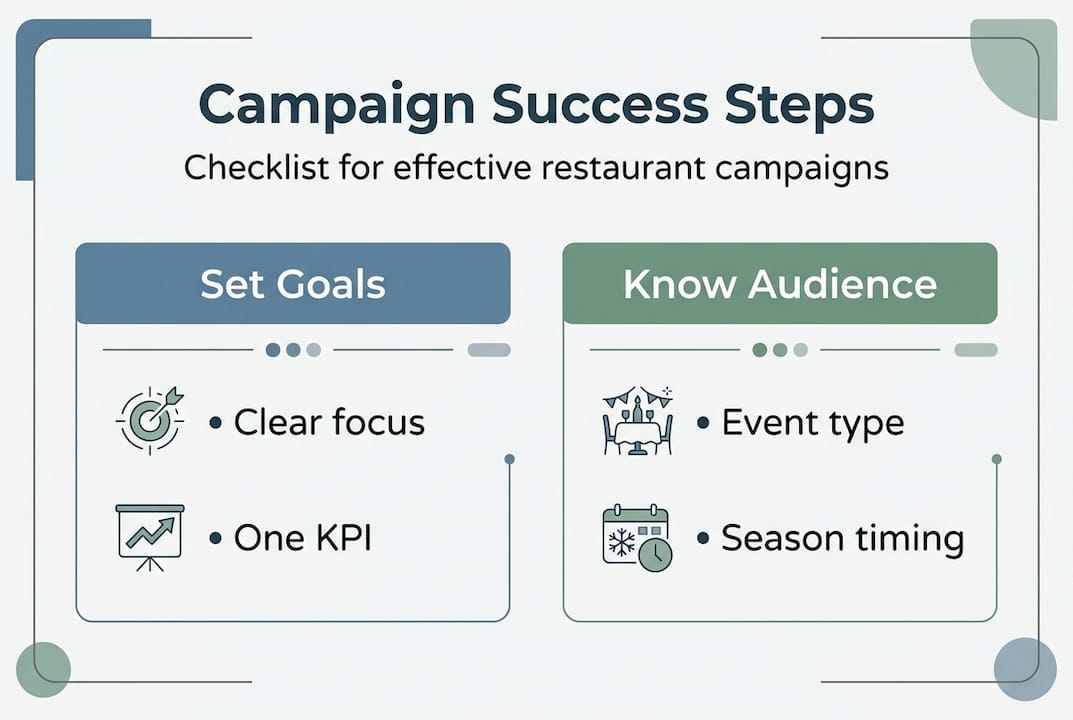
Before you write a single caption or design a single graphic, lock in your campaign goal. Are you trying to fill seats during slow weekday lunch hours? Do you want to drive more corporate holiday party inquiries? Are you launching a new happy hour program and need local regulars to spread the word? Each of these goals requires a different message, a different audience, and a different strategy.
Common campaign goals for restaurants:
- 🎯 Increase private event bookings (corporate, weddings, birthday parties)
- 🍹 Drive traffic during off-peak hours with happy hour or limited-time offers
- 📲 Grow your email list or social following to build long-term reach
- 🍽️ Promote a seasonal menu or new dish launch
- ⭐ Collect more online reviews to boost local search visibility
Once you pick your goal, define who you’re talking to. A corporate client booking a client dinner needs to see something very different from a local couple looking for a date night spot. Segmenting your audience into specific groups like corporate event planners, local food lovers, or past guests makes your message hit harder and convert better.
For private event campaigns specifically, you need to plan way ahead. According to proven event marketing strategies, corporate clients typically start researching venues months before their event date. Experts recommend starting 90 to 120 days early for corporate bookings and maintaining a seasonal marketing calendar to keep momentum year-round.
Here’s why that matters. If you’re waiting until November to market your holiday party packages, you’ve already lost a huge chunk of corporate business to venues that started promoting in August. The restaurants that win private event bookings consistently are the ones treating it like a sales pipeline, not a last-minute push.
Pro Tip: Set one key performance indicator (KPI) per campaign. For event bookings, that’s inquiry forms submitted. For happy hour, it’s redemptions or covers during those hours. One metric keeps your team focused and makes success easy to measure.
Building a seasonal calendar is the move that separates reactive restaurants from proactive ones. Map out your major campaigns by quarter: Valentine’s Day, spring brunch, summer patio events, back-to-school corporate dinners, and the holiday season. Then work backward from each event to figure out exactly when to launch your marketing. This alone will put you ahead of most competitors in your market.
Essential tools and materials for restaurant campaigns
With your goals and audience in mind, you’ll need the right toolkit to execute effective campaigns. You don’t need to spend a fortune to get results, but you do need the right combination of platforms, content, and systems working together.
Core platforms every restaurant campaign needs:
- Instagram and Facebook for organic posts, Stories, and paid ads targeting local audiences
- An email marketing tool like Mailchimp or Klaviyo for direct communication with past guests
- A reservation or event booking platform like OpenTable, Tripleseat, or Resy to capture inquiries and convert interest into confirmed bookings
- A Google Business Profile to show up in local searches and display your event spaces
Creative assets are what make or break your campaign. Text-heavy static posts get scrolled past. But a short, well-lit walkthrough video of your private dining room? That stops thumbs. Platforms reward video content, and video walkthroughs, event setup photos, and Stories for private spaces are among the most effective formats for building guest vision and creating urgency.
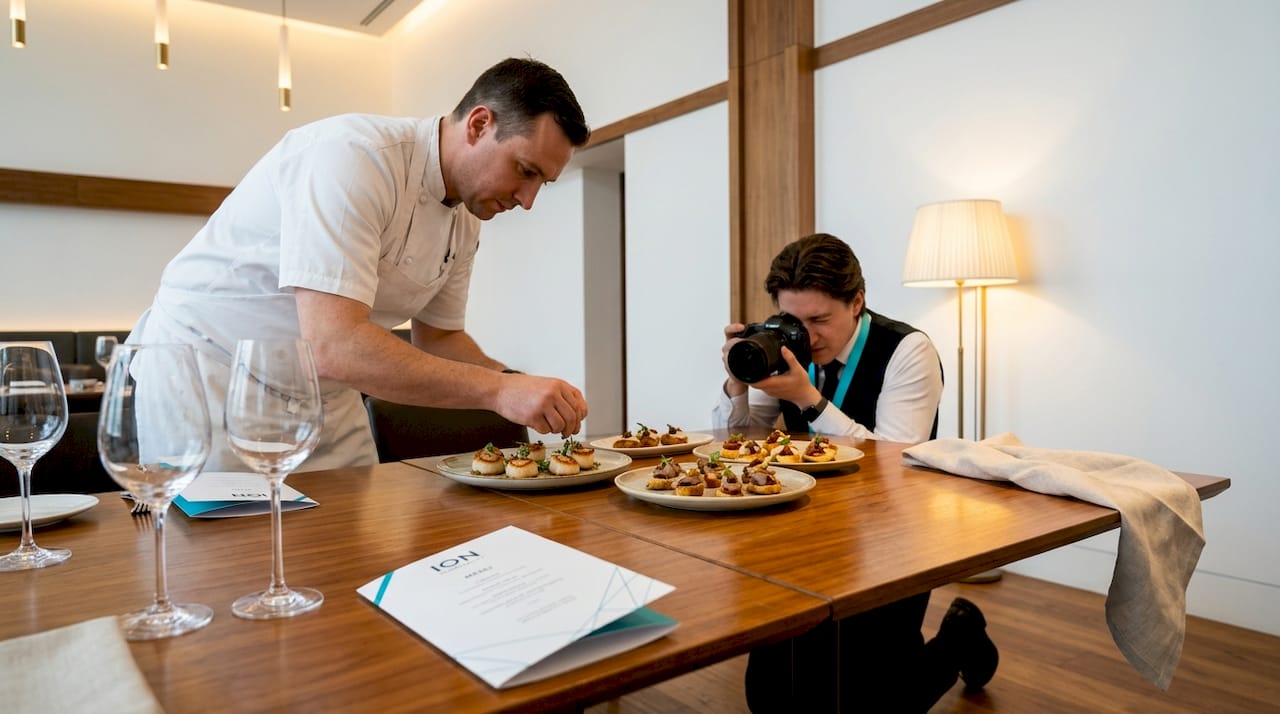
Invest time in capturing the right content. Shoot your private event space set up for a corporate dinner. Film your chef plating a signature dish. Record a behind-the-scenes of your team setting up for a birthday party. These assets can be repurposed across platforms for months. For more detailed guidance, explore these content creation tips tailored specifically for restaurants.
| Tool category | Free options | Paid options | Best for |
|---|---|---|---|
| Social media scheduling | Meta Business Suite | Hootsuite, Later | Consistent posting cadence |
| Email marketing | Mailchimp (up to 500 contacts) | Klaviyo, ActiveCampaign | Guest retention and promotions |
| Event/reservation booking | Google Forms | Tripleseat, OpenTable | Private event inquiries |
| Graphic design | Canva (free tier) | Canva Pro, Adobe Express | Campaign visuals |
| Video editing | CapCut, InShot | Adobe Premiere Rush | Reels and short-form content |
When choosing your tools, match them to your campaign complexity and budget. If you’re just starting out, free tools get the job done. As your campaigns grow more sophisticated and you’re managing multiple events per month, upgrading to paid platforms saves significant time and improves automation. You can also explore brand awareness tactics that pair well with a strong tool stack.
What to look for when selecting tools:
- ✅ Integration with your existing POS or reservation system
- ✅ Easy mobile access so your team can manage campaigns on the go
- ✅ Built-in analytics to track clicks, opens, and conversions
- ✅ Automation features that save time on follow-up emails and reminders
Don’t overcomplicate it. Start with two or three core tools, get good at them, then expand as your campaigns scale.
Step-by-step: Creating and launching your restaurant campaign
Once your toolkit is ready, you can build and launch your campaign step by step. This is where the work gets real and where most restaurants either nail it or fall apart. Follow this process every time.
1. Define your offer or hook 🎯
What are you giving people a reason to act on? This could be a limited-time discount on event space rental, a complimentary appetizer during happy hour, or an exclusive chef’s tasting menu for private groups. Your offer needs to be clear, time-bound, and compelling enough to generate action.
2. Craft your core message
Write one sentence that explains exactly what you’re offering and who it’s for. “Book our private dining room for 20 or more guests this quarter and receive a complimentary welcome cocktail hour.” Keep it specific. Vague messaging kills conversions.
3. Create your visual assets
Build your campaign around video-first content. Video content drives significantly more engagement than static posts for restaurant marketing, translating directly into more event inquiries and bookings. Shoot a 15 to 30 second reel showcasing your private space, your team, and the experience guests can expect. Back that up with still photos and a designed graphic for your email header.
4. Build your posting and sending schedule
Timing matters more than most owners realize. Here’s what works:
- Post organic content mid-week (Tuesday through Thursday) between 11 AM and 1 PM or 6 PM and 8 PM
- Send marketing emails on Tuesday or Wednesday mornings for the highest open rates
- Run paid ad campaigns for at least 7 to 10 days before your event or promotion date to build reach before the deadline hits
5. Launch across all your channels simultaneously
Post on Instagram and Facebook, send your email, and activate your paid ads on the same day. Multi-channel campaigns perform dramatically better than single-channel efforts.
6. Track and adjust in real time
Check your ad performance daily for the first 72 hours. If a video ad is outperforming a static one, shift budget toward it immediately. This is where social media ad strategies make a measurable difference.
📊 Statistic spotlight: Video content consistently outperforms static posts for restaurant marketing engagement and booking conversions. Restaurants using video in their event campaigns see significantly higher inquiry rates than those relying on photos or text-only content alone.
Pro Tip: Every photo and video you capture during an event becomes future campaign fuel. Tag and archive your event assets so you can repurpose them in remarketing ads that target people who already visited your website or engaged with past posts. Check out proven social media campaign examples to see how other restaurants pull this off effectively.
Measuring results and optimizing for future campaigns
After launch, it’s crucial to measure and refine for better results next time. Running a campaign without tracking results is like cooking a dish without tasting it. You have no idea if it’s working until it’s too late to fix anything.
Here are the core metrics every restaurant owner should monitor after a campaign goes live:
- Booking and inquiry conversions — how many people actually submitted an event form or made a reservation
- Promotion redemption rate — what percentage of people who received your offer actually used it
- Engagement rate — likes, comments, shares, and saves on your social content
- Email open and click-through rates — are people reading and responding to your messages
- Repeat visit rate — are the guests you attract coming back
“Promotion redemption rates typically range from 2% to 10%, and restaurants running coordinated multi-channel campaigns have seen revenue lifts ranging from 20% to 400%. The key is to test small before scaling.”
That benchmark is worth sitting with. A 2% redemption rate sounds low, but if you sent your offer to 2,000 past guests, that’s 40 covers you wouldn’t have had otherwise. And with revenue lifts potentially reaching 400% from a well-executed multi-channel strategy, the return on investment can be extraordinary. Start with a small test campaign, measure every touchpoint, and then scale what works.
| Metric | Benchmark target | What it tells you |
|---|---|---|
| Event inquiry conversion rate | 5–15% of landing page visits | Whether your offer and creative are compelling |
| Promotion redemption rate | 2–10% | How motivating your offer is to your audience |
| Email open rate | 20–35% | Whether your subject line and list are healthy |
| Social engagement rate | 3–6% | How relevant your content is to your followers |
| Revenue lift from campaign | 20–400% (varies by channel mix) | Overall campaign ROI and scalability |
Common mistakes that hurt campaign results:
- ❌ Not segmenting data by channel, which makes it impossible to know what’s actually working
- ❌ Attributing bookings loosely (“I think they saw our Instagram”) instead of tracking actual referral sources
- ❌ Ending campaigns too early before giving them time to gain traction
- ❌ Ignoring negative feedback or low engagement as a signal to adjust
Use the insights from each campaign to sharpen your next one. If your event inquiry video got strong engagement but low form completions, the creative worked but your landing page or call-to-action needs work. If your email open rates are high but clicks are low, the subject line is pulling people in but the offer isn’t compelling enough. Every data point is a direction to improve. Explore more on boosting restaurant revenue and hospitality marketing trends to stay ahead of what’s working in 2026.
What most restaurant campaigns miss—and how owners can stand out
Here’s something most marketing guides won’t tell you: the biggest problem with restaurant campaigns isn’t bad creative or wrong timing. It’s the lack of a system.
Most restaurants run campaigns the same way they handle a last-minute reservation rush — reactive, stressed, and inconsistent. They boost a post the week before Valentine’s Day, throw together a holiday flyer in December, and wonder why results are underwhelming. That pattern rarely produces sustainable growth.
The restaurants that consistently fill private event spaces and grow their customer base treat marketing like a kitchen operation. There’s a prep schedule. There’s a mise en place. Every campaign is planned, prepped, and executed with intention. They use a calendar-driven model where every major event or promotion is mapped out quarters in advance, with creative assets ready to go before the deadline arrives.
Consistency and creative quality beat sporadic big pushes every single time. One beautifully produced reel per week will outperform three thrown-together posts daily. And building a pipeline of private event marketing insights means you’re never scrambling for your next booking. You’re creating demand before the need even arises.
Prioritize video and visual storytelling above everything else. In a crowded feed, it’s the only thing that truly breaks through. 🎬
Elevate your restaurant marketing with expert support
Running a restaurant is already a full-time job. Adding the role of content creator, ad manager, and campaign strategist on top of it stretches most teams thin fast. That’s where the right marketing partner changes everything.
At ION Hospitality, we specialize in helping restaurants like yours get more customers in seats and book more private events without the guesswork. Our team handles your social media advertising, from scroll-stopping video content to targeted ad campaigns, all done for you with zero commissions. Whether you’re refining your ad strategies for bookings or launching a full private event campaign, we build the systems that keep your calendar full. Ready to stop leaving bookings on the table? Let’s build something that works.
Frequently asked questions
What’s the best way to promote my restaurant’s private event spaces?
Showcase video walkthroughs and event setup photos on social media to help potential guests visualize their event experience, which builds urgency and drives more direct inquiries.
How soon should I start marketing a restaurant event to boost attendance?
Start campaigns 90 to 120 days in advance for corporate events, giving your outreach enough time to reach decision-makers before they commit to another venue.
What kind of return can I expect from a restaurant marketing campaign?
With a coordinated multi-channel approach, restaurants have seen revenue lifts from 20% to 400% and promotion redemption rates between 2% and 10%, depending on offer strength and audience quality.
Are videos really better than static posts for restaurant campaign results?
Video content outperforms static posts consistently for restaurant social media engagement and booking conversions, making it the highest-priority format for any campaign.

Add a Comment