

TL;DR:
- Restaurant marketing KPIs focus on revenue-driven metrics like ROI, CAC, CRR, and CLV.
- Accurate tracking involves POS integration, UTM links, promo codes, and dedicated phone numbers.
- Prioritizing retention KPIs and customer re-engagement strategies enhances long-term growth.
You’re spending money on ads, posting on Instagram, maybe even running email campaigns. But at the end of the month, you stare at your numbers and wonder: what actually worked? Most restaurant owners feel this exact frustration. Restaurant marketing KPIs include ROI/ROAS, Customer Acquisition Cost, Customer Retention Rate, Customer Lifetime Value, conversion rates, social engagement, traffic sources, and more. These are the missing link between your marketing spend and real business outcomes. This guide breaks down the most critical KPIs, how to track them, and how to use them to make smarter decisions that fill more seats and book more events.
Table of Contents
- What are restaurant marketing KPIs and why do they matter?
- The essential restaurant marketing KPIs: Definitions and benchmarks
- How to track restaurant marketing KPIs accurately
- KPIs for revenue, loyalty, and customer engagement: Putting metrics to work
- Advanced tactics, mistakes, and what most experts miss
- The real secret: The KPIs most restaurant owners overlook
- Ready to take control of your restaurant’s marketing KPIs?
- Frequently asked questions
Key Takeaways
| Point | Details |
|---|---|
| Focus on real KPIs | Tracking ROI, retention, and customer value gives you actionable insights beyond social impressions. |
| Retention beats acquisition | Loyalty and repeat business are 3x more valuable than chasing new guests alone. |
| Tie marketing to sales | Connect digital marketing results to revenue and bookings for true impact measurement. |
| Benchmark for better decisions | Use current industry benchmarks to set realistic KPI targets and spot opportunities. |
| Avoid common pitfalls | Bypassing vanity metrics and measuring what matters prevents wasted spend and effort. |
What are restaurant marketing KPIs and why do they matter?
KPI stands for Key Performance Indicator. In plain terms, it’s a measurable value that tells you whether your marketing is actually working. Not just getting clicks or likes, but driving reservations, online orders, repeat visits, and private event bookings.
Here’s where most restaurant owners get tripped up: they mix operational KPIs (like food cost percentage or labor hours) with marketing KPIs. These are different animals. Marketing KPIs specifically measure how well your campaigns, channels, and content move customers through the door or to the checkout screen.
The core restaurant marketing KPIs you need to know:
- 📊 ROI/ROAS (Return on Investment / Return on Ad Spend)
- 👤 CAC (Customer Acquisition Cost)
- 🔄 CRR (Customer Retention Rate)
- 💰 CLV (Customer Lifetime Value)
- 📧 Email open and click rates
- 📱 Social engagement rates
- 🖥️ Website conversion rates (online ordering, reservations)
- 🔗 Traffic sources (organic, paid, social, direct)
- 💸 CPC and CPA (Cost Per Click / Cost Per Acquisition)
The biggest trap? Obsessing over vanity metrics. Impressions and follower counts feel good but they don’t pay your staff. The goal is to focus on metrics tied to revenue and foot traffic.
“A 5% increase in customer retention can boost profits by 25%. Retained customers are 3.3x more valuable than new ones.”
That stat alone should shift how you think about where your marketing dollars go. Chasing new customers while ignoring existing ones is one of the most expensive mistakes in the industry.
When you work on boosting brand awareness, the KPIs you choose determine whether that effort translates into real revenue or just noise. Choose the right indicators, and every campaign becomes a learning opportunity.
Now that you see how KPIs can provide clarity, let’s break down the most critical ones for US restaurants.
The essential restaurant marketing KPIs: Definitions and benchmarks
Knowing the names of KPIs is one thing. Understanding what they mean, what good looks like, and how to use them is another. Here’s your quick-reference breakdown.
| KPI | What it measures | Benchmark |
|---|---|---|
| ROI/ROAS | Revenue earned per dollar spent | ROAS of 3x+ is strong |
| CAC | Cost to acquire one new customer | Aim below avg. check value |
| CRR | % of customers who return | 40-60% is solid for casual dining |
| CLV | Total revenue per customer over time | Higher = healthier loyalty |
| Email open rate | % of recipients who open emails | 20-30% is a good target |
| Social engagement | Likes, shares, comments per post | 1-5% engagement rate |
| Conversion rate | % of web visitors who order or book | 2-5% for online ordering |
| CPC | Cost per ad click | Varies; lower is better |
| CPA | Cost per new customer acquired | Should not exceed CLV |
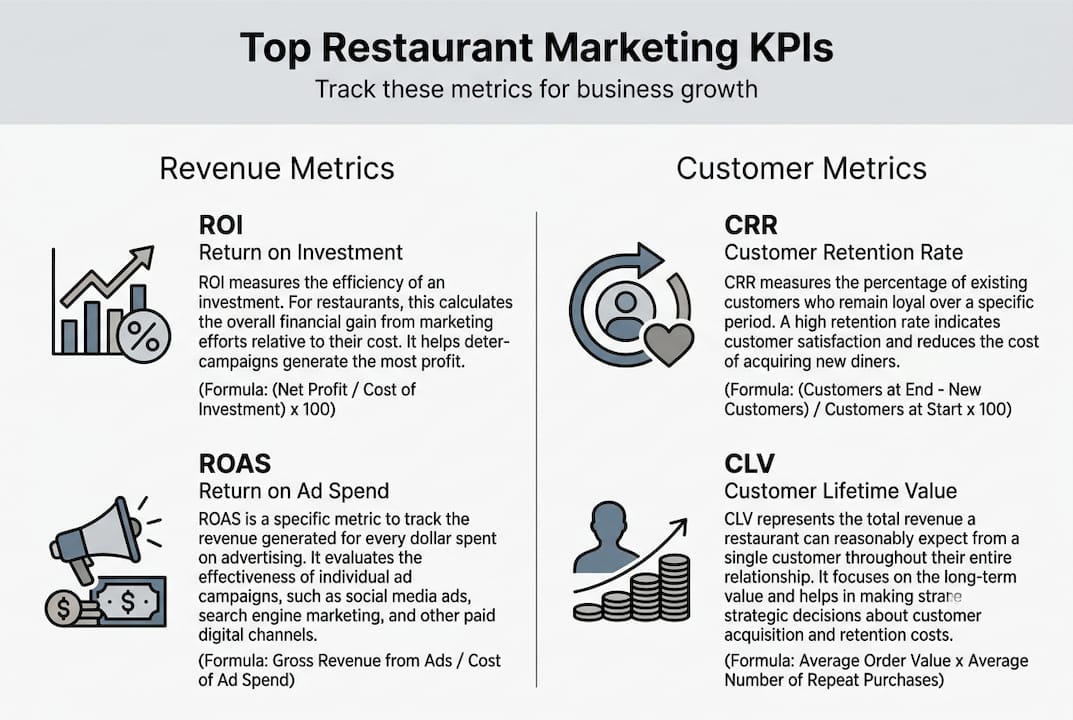
Marketing budgets for established US restaurants sit at 3-6% of revenue, while growth-stage restaurants invest up to 10-15%, with 60-80% directed to digital channels. Knowing your benchmarks helps you evaluate whether you’re over or underspending in any area.
Different goals demand different KPIs. If retention is your priority, focus on CRR and CLV. If you’re running paid campaigns to acquire new guests, CAC and CPA tell the real story. Use monitoring online trends to stay ahead of what’s resonating with your audience before your competitors do.
For social campaigns, your Instagram marketing ideas live or die by engagement rate and the conversion traffic they send to your reservation or ordering page.
KPIs to prioritize by goal:
- 🎯 Growing new customers: CAC, CPA, conversion rate
- 🔁 Improving retention: CRR, CLV, loyalty activation rate
- 📣 Content and social performance: Engagement rate, reach, traffic source
- 💌 Email campaigns: Open rate, click rate, revenue per email sent
Pro Tip: Start with conversion rate and CRR. These two KPIs are directly tied to revenue and can show measurable improvement within 30 to 60 days of focused effort.
With these definitions in mind, how do you actually measure progress and avoid common mistakes?
How to track restaurant marketing KPIs accurately
Tracking KPIs sounds technical, but the process is straightforward when you have the right setup. The bigger risk is not tracking at all, or tracking the wrong things.
Here’s a step-by-step process to get your measurement system in place:
-
Set up your POS integration. Your point-of-sale system is the backbone of revenue attribution. Make sure it connects to your marketing tools so you can see which campaigns drove actual purchases. POS integration and UTM links are the foundation of real attribution.
-
Use UTM parameters on every link. UTMs are tags added to URLs that tell Google Analytics where your traffic came from. Every email, social post, and ad should have unique UTMs so you know exactly what’s driving website visits.
-
Create unique promo codes per channel. Running a Facebook ad and an email campaign at the same time? Give each one a unique discount code. When a guest redeems it, you know exactly which channel drove them in.
-
Set up unique phone numbers. If you’re running local ads or print promotions, use a dedicated phone number for each campaign. Call tracking tools make this easy and affordable.
-
Build a simple reporting dashboard. Pull your key metrics weekly into a single view. Google Analytics, your email platform, and your POS should all feed into one place.
-
Compare against baselines. A metric means nothing without context. Set your baseline numbers in week one, then measure week-over-week and month-over-month changes.
Common pitfalls to avoid:
- ❌ Measuring only likes and follower counts as success metrics
- ❌ Running campaigns without UTMs or promo codes so you can’t attribute results
- ❌ Ignoring offline conversions like phone reservations and walk-ins
- ❌ Skipping your brand awareness strategies check-ins between campaign cycles
Using retargeting ads tips can also help you close the loop on website visitors who didn’t convert the first time, and proper tracking lets you measure exactly how well retargeting pays off.
Pro Tip: After every campaign, run a simple attribution check. Ask: which channel generated the most actual purchases, not just traffic? That answer should guide your next budget decision.
Accurate tracking is vital, but how can you use KPIs for deeper customer engagement and long-term growth?
KPIs for revenue, loyalty, and customer engagement: Putting metrics to work
Tracking KPIs is just step one. The real advantage comes when you use them to make smarter decisions, adjust your programs, and build lasting customer relationships.
High-performing restaurants treat loyalty KPIs as seriously as their food costs. Metrics like loyalty activation rate (the point at which a guest makes their third purchase and becomes a long-term regular), revenue capture from loyalty programs, and 180-day retention rate tell you whether your loyalty efforts are actually working.
Loyalty programs increase traffic and revenue, with the majority of operators agreeing they drive results. And 62-78% of consumers say loyalty membership influences where they choose to eat. That’s a massive edge if you’re measuring and optimizing your program.
Retention vs. acquisition: A quick comparison
| Metric | Retention focus | Acquisition focus |
|---|---|---|
| Cost efficiency | High (lower spend per guest) | Low (higher cost per new guest) |
| Revenue impact | Compounding over time | One-time unless retained |
| Best KPIs | CRR, CLV, activation rate | CAC, CPA, conversion rate |
| Risk level | Low | Higher (spend with uncertain return) |
Use new customer strategies to fill the top of your funnel, but make sure you’re measuring whether those new guests come back. If your acquisition cost is high and retention is low, you’re running in place.
Quick wins to improve engagement KPIs:
- ✅ Test two different email subject lines (A/B test) and measure open rates
- ✅ Personalize offers based on past order behavior
- ✅ Segment your email list by visit frequency and send targeted campaigns
- ✅ Use time-sensitive offers to increase redemption rates and urgency
- ✅ Track which social media campaigns generate the most repeat visitors, not just one-time clicks
Now that you have a playbook for using KPIs, let’s consider some advanced strategies and common misconceptions.
Advanced tactics, mistakes, and what most experts miss
Most articles stop at “track your metrics.” But there’s a layer of nuance that separates restaurants that improve from those that just collect data.
The first big mistake: measuring what’s easy instead of what matters. Likes and follows are easy to report. Incremental revenue lift from a specific campaign is harder to calculate but infinitely more useful. Email delivers the highest ROI of any digital channel, but only if you tie it to actual revenue outcomes, not just open rates.
The second mistake: blending financial operations KPIs with marketing KPIs. Tracking food cost percentage alongside email conversion rate in the same report muddies your analysis. Keep marketing metrics in their own reporting lane so you can clearly see what’s working.
“Measure incremental revenue from each campaign, and be cautious of ad fraud in paid channels, especially on newer platforms where reporting transparency is lower.”
Essential do’s and don’ts for KPI interpretation:
- ✅ Do use unique offer codes to measure incremental lift from each specific campaign
- ✅ Do review your evolved marketing strategies quarterly to realign KPIs with current goals
- ✅ Do track private event inquiries and bookings as a conversion KPI, especially if events are a revenue target
- ❌ Don’t treat paid search as a guaranteed win; its ROI is variable and depends heavily on targeting quality
- ❌ Don’t ignore ad fraud; some platforms inflate click numbers, so always cross-reference with actual on-site behavior
- ❌ Don’t wait until the end of a campaign to check results; weekly check-ins let you pivot before money is wasted
For event strategies, KPIs like cost per private event inquiry, conversion rate from inquiry to booking, and revenue per event are critical and often overlooked by restaurant owners focused only on dining room covers.
Completing the tactical overview, let’s shift gears and offer a seasoned perspective that challenges some industry assumptions.
The real secret: The KPIs most restaurant owners overlook
Here’s something we see constantly: restaurant owners obsess over CAC and CLV as if those two numbers are the whole story. They’re not.
CAC tells you what it costs to bring someone in once. CLV estimates how much they’re worth over time. But neither number protects you if guests aren’t actually coming back. Without activation, your CLV is fiction. A guest who visits once and never returns doesn’t have a “lifetime value,” they have a single transaction.
The KPIs that actually move the needle long-term are the ones tied to repeat behavior. Loyalty activation rate (that third visit threshold), 180-day retention rate, and incremental revenue per campaign. These are boring to talk about but extraordinary in practice.
We’ve seen restaurants triple their repeat visit rate by focusing entirely on the post-first-visit experience and measuring it with the right KPIs. That’s more powerful than doubling your ad budget. The 2026 marketing trends confirm this shift: smart operators are moving budget from acquisition to retention because the data is undeniable.
Stop chasing clicks. Start measuring whether guests come back, and build every campaign around improving that number.
Ready to take control of your restaurant’s marketing KPIs?
You now have the framework to measure what actually matters: not vanity metrics, but real indicators of customer behavior, campaign performance, and revenue growth. Knowing your KPIs is the first step. Executing on them consistently is where most restaurants fall short.
At ION Hospitality, we help restaurants turn marketing data into filled seats, more online orders, and booked private events. Our done-for-you social media advertising is built around the KPIs that drive real growth, and we never take a commission. Ready to stop guessing and start growing? Learn how to attract more customers online with a strategy built around the metrics that matter most to your bottom line.
Frequently asked questions
What are the most important restaurant marketing KPIs?
ROI/ROAS, CAC, CRR, and conversion rates are the most impactful restaurant marketing KPIs because they connect your marketing spend directly to revenue, customer behavior, and long-term profitability.
How do I measure marketing ROI in my restaurant?
Use the formula: ROI = (Revenue minus Costs) divided by Costs, then multiply by 100 to get your percentage return per campaign or channel.
What is a good marketing budget for a restaurant?
Established US restaurants typically spend 3-6% of revenue on marketing, while growth-stage restaurants may invest 10-15%, with the majority going to digital channels.
How can I link digital marketing to real-world sales?
Integrate your POS system, apply UTM links and promo codes to every campaign, and use unique phone numbers per channel to connect online activity to actual in-restaurant purchases.
Do loyalty programs really drive restaurant growth?
Yes. 62-78% of consumers say loyalty membership influences where they dine, and most operators confirm that loyalty programs directly increase traffic and revenue.

Add a Comment