
TL;DR:
- Strategic seasonal marketing aligns promotions with customer behaviors, holidays, and local events.
- Planning campaigns 2-3 months ahead and using multi-channel promotion enhances effectiveness.
- Creating experiences and building local traditions foster loyalty better than discounts.
Most restaurant owners think seasonal marketing means putting a pumpkin spice special on the menu in October or running a Valentine’s Day prix-fixe. That’s not a strategy. That’s a reaction. Seasonal restaurant marketing is actually the practice of planning your promotions, menus, and campaigns around seasons, holidays, weather, and local events to leverage customer behavior shifts, create urgency through limited-time offers, and consistently drive traffic and revenue. When you approach it with intention, it becomes one of the most powerful tools in your entire marketing playbook.
Table of Contents
- What is seasonal restaurant marketing?
- Building a seasonal restaurant marketing calendar
- Popular seasonal marketing tactics and what actually works
- Maximizing impact: timing, targeting, and local relevance
- Discounts versus experiences: what builds loyalty and revenue?
- The real secret to seasonal restaurant marketing: don’t chase trends, build local moments
- Level up your seasonal marketing with expert support
- Frequently asked questions
Key Takeaways
| Point | Details |
|---|---|
| Proactive planning wins | Building an annual marketing calendar drives better seasonal results than reacting last minute. |
| Evidence beats guesswork | Empirical data shows seasonal menus, experiences, and local events substantially boost sales. |
| Discounts aren’t necessary | Focus on experiences and scarcity instead of training guests to expect discounts. |
| Leverage multiple channels | Combine SMS, social, email, and influencers for the most effective seasonal promotions. |
| Local relevance matters | Tailoring tactics to your audience and community enhances engagement and customer loyalty. |
What is seasonal restaurant marketing?
To understand how to apply this concept, let’s clarify exactly what seasonal restaurant marketing is and why it matters.
Seasonal marketing is not just about holidays. It’s a structured approach to coordinating your promotions and menu offerings with the natural rhythms of your customers’ lives. Weather changes, local festivals, school calendars, sports seasons, and cultural moments all influence when and why people go out to eat. Your job is to meet them where they are.
Seasonal marketing campaigns work because they tap into shifting customer behavior with targeted momentum. When someone sees a limited-time summer cocktail menu or a Friendsgiving event with only 40 seats available, they feel urgency. That urgency drives action.
Here’s what seasonal marketing actually covers:
- 🗓️ Holidays and observances: Valentine’s Day, Mother’s Day, Thanksgiving, New Year’s Eve
- 🌤️ Weather and seasons: Summer patio season, cozy fall menus, winter comfort food
- 🎉 Local events: Neighborhood festivals, sports playoffs, college graduation weekends
- 🌱 Ingredient availability: Farm-to-table specials tied to what’s fresh and local
- 📅 Cultural moments: Back-to-school, Super Bowl Sunday, Pride Month
“Seasonal marketing done right fills tables during both peak and slow periods. It’s not just about riding the wave. It’s about creating waves of your own.”
When you use seasonal marketing to attract new restaurant customers, you’re building a reason for people to choose you over the competition. Combine that with restaurant event marketing strategies and you have a system that fills seats consistently. And if you want to pack the room fast, pairing this with crowd marketing strategies amplifies every campaign you run.
Building a seasonal restaurant marketing calendar
Having defined what seasonal marketing is, the next step is to operationalize it with a robust calendar and planning process tailored to your restaurant.
A reactive restaurant scrambles to throw together a St. Patrick’s Day promotion two weeks out. A proactive restaurant has already locked in the menu, the social content, the email sequence, and the reservation system by early February. The difference is a calendar.
Here’s how to build yours:
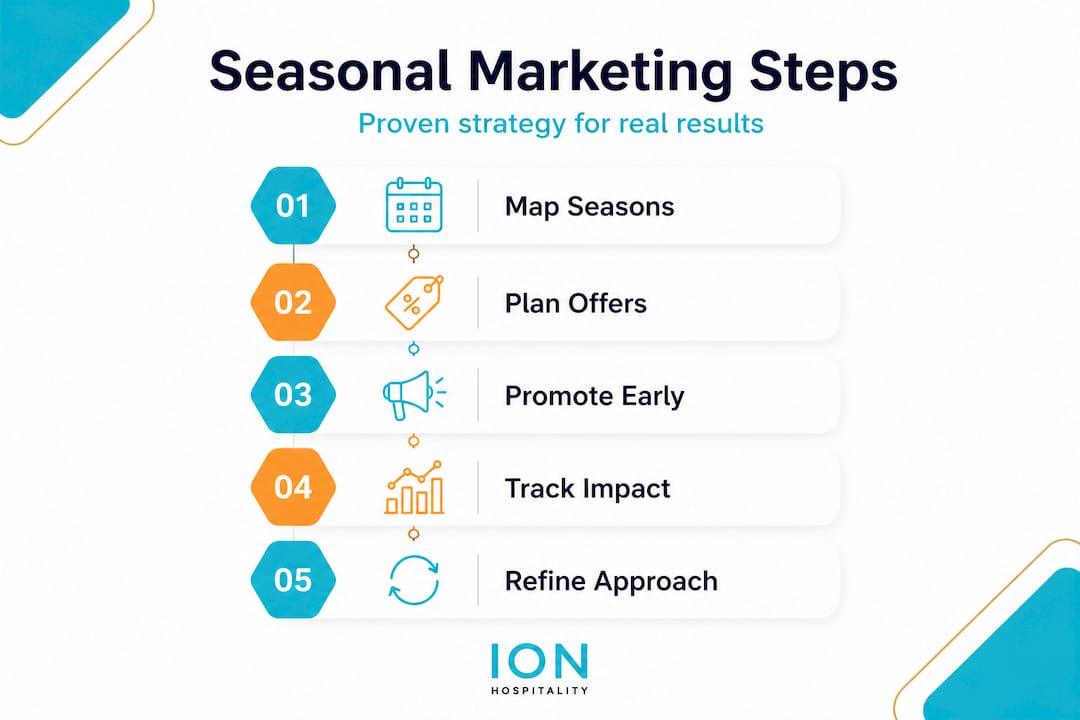
- Map your full year first. Identify every major holiday, local event, and seasonal shift relevant to your market and concept. A beachfront seafood spot has different peaks than a downtown steakhouse.
- Layer in your ingredient calendar. Know when local produce, proteins, and specialty items are at their best and most affordable. Build menus around those windows.
- Set SMART goals for each campaign. Specific, Measurable, Achievable, Relevant, and Time-bound. “Increase covers by 20% on Mother’s Day weekend” beats “do better this spring.”
- Budget 3-6% of annual revenue for marketing. According to seasonal marketing best practices, this range is the sweet spot for most independent and small-chain restaurants. Underfunding your marketing is one of the fastest ways to stay invisible.
- Start major campaign planning 2-3 months in advance. For Thanksgiving, that means your planning starts in August. For Valentine’s Day, start in November. Campaigns that launch early consistently outperform last-minute efforts.
- Use multi-channel promotion. Email, SMS, social media, and micro-influencers all working together beat any single channel alone.
- Analyze after every campaign. Pull your POS data. What drove covers? What bombed? Use that to sharpen the next round.
| Planning phase | Timeline before event | Key activities |
|---|---|---|
| Strategy & concept | 10-12 weeks | Menu development, goal setting, budget allocation |
| Content creation | 6-8 weeks | Photography, copy, social assets, email sequences |
| Campaign launch | 4-6 weeks | Social posts, email blasts, influencer outreach |
| Final push | 1-2 weeks | SMS reminders, urgency-driven posts, reservation alerts |
| Post-campaign review | 1-2 weeks after | POS analysis, engagement metrics, customer feedback |
Pro Tip: Don’t just track revenue. Track reservation conversion rates, average check size, and social engagement per campaign. Those numbers tell you why something worked, not just that it worked. Pair this with strong content creation strategies and you’ll have a feedback loop that keeps improving every season. Stay ahead of the curve by keeping an eye on hospitality marketing trends as part of your annual planning process.
Popular seasonal marketing tactics and what actually works
With your calendar mapped out, here are the proven tactics and evidence that actually move the needle for full-service restaurants.
Not all tactics are created equal. Some look good on paper but don’t translate to real revenue. Here’s what the data says actually works:
- 🍂 Limited-time seasonal menus: Seasonal menus drive a 26% jump in orders. That’s not a small lift. A well-executed fall menu with three to five signature items creates buzz, drives social sharing, and gives your regulars a reason to come back.
- 🏷️ Seasonal labeling on dishes: 59% of consumers actively prefer dishes labeled as seasonal. Simply calling something a “summer harvest salad” instead of “mixed greens” changes how guests perceive value.
- 🎁 Gift card specials around holidays: During Black Friday 2024, US restaurant gift cards hit $17.5 million in sales, up 10.8% year over year. Gift card bonuses like “buy $50, get $10 free” consistently outperform straight discounts because they bring customers back.
- 📱 SMS marketing for limited-time alerts: SMS carries a 98% open rate. When you drop a flash reservation window or a 48-hour seasonal special, text is the channel that gets seen.
- 🤳 Micro-influencer previews: Forget celebrity partnerships. A campaign using 8 micro-influencers with 5,000 to 30,000 followers generated 280,000 impressions and 47 direct reservations. The ROI on micro-influencers is consistently stronger because their audiences are local and engaged.
- 🎉 Themed events: Friendsgiving dinners, Mother’s Day brunch packages, New Year’s Eve prix-fixe seatings. These create experiences, not just meals.
| Tactic | Average impact | Best season to deploy |
|---|---|---|
| Limited-time seasonal menu | +26% order volume | All seasons |
| Seasonal dish labeling | +59% consumer preference | All seasons |
| Gift card bonus offers | +10.8% YoY sales lift | Holiday season |
| SMS promo alerts | 98% open rate | Any time-sensitive offer |
| Micro-influencer preview | 280k impressions per campaign | Pre-season launch |
| Prix-fixe holiday menus | Higher average check | Major holidays |
📊 Stat callout: Valentine’s Day and Mother’s Day are the top two revenue-generating holidays for full-service restaurants in the US. If you’re not running a structured campaign for both, you’re leaving serious money on the table.
Keep an eye on what competitors and local leaders are doing by monitoring online trends. Spotting what’s gaining traction early gives you a first-mover advantage in your market.
Maximizing impact: timing, targeting, and local relevance
Even great tactics can fall flat without smart timing and local targeting. Here’s how to be proactive and avoid common traps.
Timing is everything. Restaurants that start campaigns in late October for the holiday season consistently outperform those that wait until November. The window to capture attention is shorter than most owners realize.
Here’s how to time and target your campaigns effectively:
- Plan around demand peaks. April through August brings weather-driven traffic and tourism. November through January brings holiday diners. Full-service restaurants that use prix-fixe menus, catering offers, and experience-driven events during these windows see the strongest returns. Build your biggest campaigns around these peaks.
- Prepare for the post-holiday slump. January and February are notoriously slow. Don’t just wait it out. Launch health-focused menus, Dry January cocktail programs, or “new year, new experience” themed dinners to maintain momentum.
- Localize everything. A generic “spring promotion” doesn’t resonate. A campaign tied to your city’s annual food festival, local sports team’s playoff run, or neighborhood block party does. Local events create pop-up opportunities that national chains can’t replicate.
- Tailor to your actual audience. A mom-focused Mother’s Day campaign outperforms a generic “spring cleaning” promotion every time. Know who your guests are and speak directly to them.
- Test, analyze, and cut what isn’t working. Don’t run the same campaign twice just because you ran it last year. Discipline in seasonal planning means being willing to retire underperforming ideas and double down on what resonates.
“67% of holiday diners are actively seeking experiences that go beyond standard dining. That means your seasonal campaign needs to offer something memorable, not just a discounted plate.”
Pro Tip: Build scarcity into your seasonal offers. “Only 20 seats available for our harvest dinner” creates urgency that no discount can match. Pair this with strong event marketing strategies and you’ll see reservations fill up weeks in advance. Make sure your online restaurant presence is optimized so that when people search for seasonal dining options, you show up first.
Discounts versus experiences: what builds loyalty and revenue?
One of the biggest debates among restaurateurs is discounting versus experience creation. Here’s how the approaches stack up.
Heavy discounting feels like a quick win. You run a 20% off promotion, covers spike for a weekend, and it looks like success. But here’s the problem: discounts train customers to wait. They learn that if they hold off, a deal is coming. Over time, you erode your margins and devalue your brand.
| Approach | Short-term impact | Long-term effect | Margin impact |
|---|---|---|---|
| Heavy discounting | High volume spike | Trains deal-seeking behavior | Negative |
| Scarcity-based offers | Moderate volume | Builds urgency and exclusivity | Neutral to positive |
| Experience-driven events | Moderate to high volume | Builds loyalty and word of mouth | Positive |
| Personalized campaigns | Targeted volume | Deepens guest relationships | Positive |
Experiences and scarcity do the opposite of discounts. They increase perceived value. A $95 per person harvest dinner with a local farmer Q&A, a paired wine flight, and a take-home recipe card feels worth more than a $95 meal with 20% off. The guest spends the same or more, your margins stay intact, and they tell their friends.
Here’s what experience-driven seasonal marketing looks like in practice:
- 🍷 Winemaker dinners tied to fall harvest season
- 🥂 New Year’s Eve countdown packages with champagne toast and live entertainment
- 🌮 Chef’s table experiences featuring seasonal ingredients with storytelling
- 🎃 Halloween costume contests with themed cocktail menus and social media sharing incentives
- 💐 Mother’s Day brunch with a flower arrangement station as an add-on experience
Story-driven, brand-aligned campaigns consistently outperform generic holiday discounts. When your seasonal marketing reflects your restaurant’s personality and values, guests connect with it on a deeper level. That connection drives loyalty, repeat visits, and referrals.
Pro Tip: Build your restaurant brand awareness through seasonal storytelling. Share the story behind your fall menu ingredients, introduce the local farm you partner with, or document the process of creating a signature holiday cocktail. Content like this builds emotional connection and keeps guests engaged between visits.
The real secret to seasonal restaurant marketing: don’t chase trends, build local moments
After seeing the evidence and tactics, here’s a perspective you won’t hear from most consultants.
The biggest mistake we see restaurant owners make is copying what worked for someone else. They see a viral pumpkin cocktail on Instagram and immediately try to replicate it. They read about a successful Friendsgiving campaign from a restaurant in Austin and paste it onto their Boston neighborhood spot. It rarely works. And when it doesn’t, they blame the strategy instead of the execution.
Here’s the truth: the restaurants that win at seasonal marketing are not the ones chasing trends. They’re the ones building their own moments. Think about the restaurant in your city that does the same annual crawfish boil every spring and has a waitlist six weeks out. Or the neighborhood Italian place that hosts a New Year’s Eve dinner so beloved that regulars book it in October. Those aren’t trends. Those are traditions. And traditions create loyalty that no discount ever could.
The way you build those moments is by listening to your guests. Survey them. Watch what they share on social. Pay attention to what they talk about at the table. Your best seasonal campaign ideas are already sitting in your dining room. You just have to ask.
Then test small. Run a one-night seasonal event before committing to a full campaign. See what resonates. Iterate. Own the outcome. When something clicks, build on it year after year until it becomes the thing your restaurant is known for. That’s how you stop chasing trends and start setting them.
Level up your seasonal marketing with expert support
Ready to drive more revenue and loyalty year-round?
Seasonal marketing works best when it’s consistent, strategic, and executed with precision. But between managing your floor, your team, and your kitchen, most restaurant owners simply don’t have the bandwidth to build and run campaigns at this level on their own. That’s where having the right support changes everything.
At ION Hospitality, we specialize in helping full-service restaurants turn seasonal opportunities into packed dining rooms and booked-out private events. From building social media engagement that drives real reservations to executing social media campaign ideas that go viral in your local market, we handle it all with zero commissions. Check out our brand awareness guide to see how we help restaurants build the kind of recognition that makes every seasonal campaign more powerful than the last.
Frequently asked questions
What is the main goal of seasonal restaurant marketing?
The main goal is to align promotions, menus, and campaigns with customer demand shifts during seasonal peaks and events for higher traffic and sales.
When should I start planning my seasonal restaurant campaigns?
Begin planning major seasonal campaigns 2-3 months before the event or holiday to give yourself enough runway for content, reservations, and promotion.
Do limited-time menus really boost restaurant sales?
Yes. Seasonal menus increase orders by about 26% on average, making them one of the highest-ROI tactics available to full-service restaurants.
How can I avoid losing money with discounts during seasonal campaigns?
Focus on creating unique experiences, leveraging scarcity over discounts, and using data-driven targeting to protect your margins while building long-term loyalty.
Which channels are best for seasonal restaurant promotions?
A multi-channel approach covering SMS, email, social media, and micro-influencers delivers the highest engagement and ROI for seasonal campaigns.

Add a Comment