
TL;DR:
- Consistent social media posting attract more foot traffic and private event bookings.
- Video content showcasing spaces, menus, and testimonials significantly boost engagement and sales.
- Tracking benchmarks and maintaining scheduling discipline are key to long-term content success.
Every week you’re not posting scroll-stopping content, someone else is filling their dining room and booking their private event spaces. Restaurants with low social media engagement miss out on measurable revenue because guests simply don’t know what’s happening inside your four walls. This guide cuts straight to what works: building a repeatable content system that drives foot traffic, grows your online community, and converts followers into private event clients. You’ll walk away with tools, tactics, and benchmarks to measure every step of the way.
Table of Contents
- What you need to launch an effective restaurant content strategy
- Step-by-step content creation process for restaurants
- Specialized content to boost private event bookings
- Measuring success: Engagement and booking benchmarks for restaurants
- An insider perspective: Why most restaurant content strategies fail (and how to fix it)
- Take your restaurant content to the next level
- Frequently asked questions
Key Takeaways
| Point | Details |
|---|---|
| Consistency is critical | Posting 5-7 times per week across platforms drives sustainable engagement and bookings. |
| Showcase private event potential | Aspirational visuals of special setups and personalized experiences fuel more event inquiries. |
| Track relevant KPIs | Use 2026 benchmarks to assess content performance and refine your strategy based on real results. |
| Content planning saves time | Batch-creating and scheduling content keeps teams consistent and avoids last-minute stress. |
What you need to launch an effective restaurant content strategy
Now that you understand why strategic content matters, let’s cover what you’ll need to do it right.
Most restaurant owners jump straight to posting without a plan. That’s like prepping a menu without knowing your food cost. You need the right tools in place before you hit publish.
Here’s what your content toolkit should include:
- 📅 Content calendar — Plan posts weekly or monthly so you never scramble for ideas
- 📷 Photo and video equipment — A modern smartphone is enough to start; a ring light and tripod help immediately
- 📱 Social media platforms — Instagram and TikTok are your priority; Facebook for events and local reach
- 📧 Email marketing system — Tools like Mailchimp or Klaviyo nurture past guests and promote upcoming events
- 🌐 Website CMS — Your site needs a blog and an events page to capture organic search traffic
Tool overview: What each piece does for you
| Tool | Primary Role | Why It Matters |
|---|---|---|
| Content Calendar | Planning and scheduling | Eliminates guesswork; keeps you consistent |
| Instagram / TikTok | Visual storytelling | Drives discovery and engagement |
| Email Platform | Nurture and conversion | Reconnects past guests with current offers |
| Website CMS | SEO and bookings | Converts traffic into reservations and event leads |
| Analytics Dashboard | Performance tracking | Shows what content actually drives results |
A solid content marketing plan for restaurants builds around content pillars posted consistently 5 to 7 times per week, prioritizing Reels and Stories, while weaving in local SEO and email nurture sequences. That’s not optional. That’s the baseline.
The good news? You don’t need a full marketing team to pull this off. You need a system. Prioritize visual content above all else. A 15-second Reel of your chef plating a signature dish will always outperform a static graphic with your lunch specials.
Pro Tip: Block two hours every Monday morning to plan your content for the week. Batch your photo and video shoots during a slow prep shift. This single habit will do more for your consistency than any tool you buy.
Invest time in content creation strategies that are built specifically for restaurants. Generic marketing advice rarely accounts for the unique rhythms of the hospitality industry: happy hours, seasonal menus, private events, and late-night rushes.
Step-by-step content creation process for restaurants
With your tools ready, follow these steps for seamless and effective content execution.
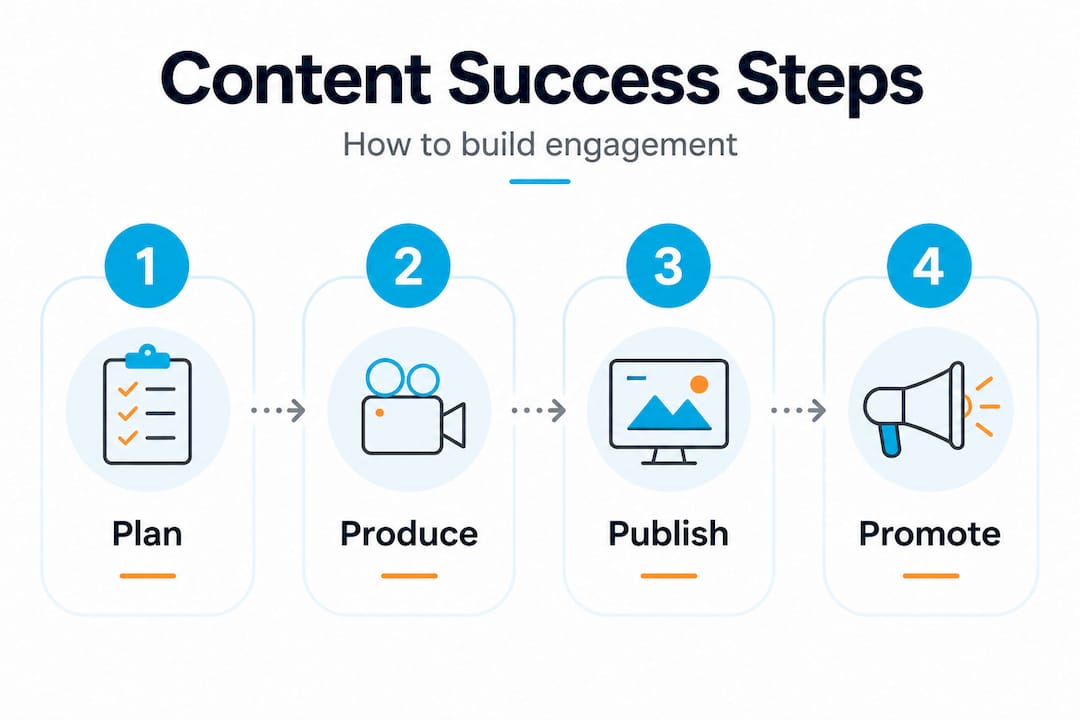
The four-phase workflow 🎬
1. Plan
Start with a weekly content calendar organized around content pillars. A pillar is simply a recurring content theme. Here are five that work across almost every restaurant concept:
- Weekly specials — Feature a dish or drink highlight every week
- Behind the scenes — Show kitchen prep, staff stories, and supplier visits
- Private event showcases — Set the scene for future hosts
- Guest reviews and testimonials — Real social proof from real diners
- Seasonal campaigns — Connect your content to holidays, local events, and limited-time menus
Assign each pillar to a specific day. Monday for specials. Wednesday for behind the scenes. Friday for event content. Now your week has structure.
2. Produce
Capture high-quality visuals during your prep hours. You don’t need perfection. You need authenticity. Walk through your event space on camera. Film a table being set for a corporate dinner. Show your bartender crafting a signature cocktail. These clips are gold.
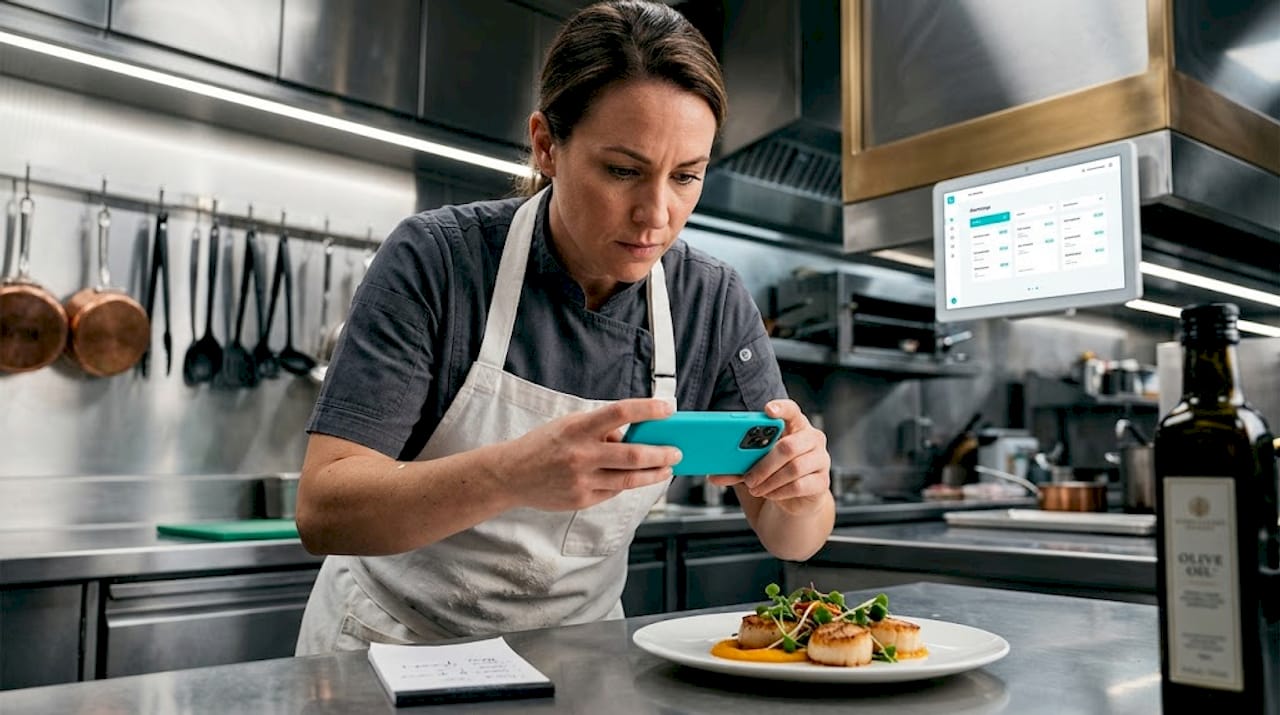
Use natural light whenever possible. Film horizontally for YouTube and vertically for Reels and TikTok. Always capture more footage than you think you need. You can always cut it down, but you can’t go back and reshoot a moment that’s passed.
3. Publish
According to 2026 benchmarks, Instagram engagement sits at 1.65% and TikTok at 4.20%. To hit those numbers, you need to post 5 to 7 times per week on Instagram with Reels and Stories taking priority. Use targeted restaurant hashtags to extend your organic reach to local audiences actively searching for dining experiences.
Time your posts strategically. Lunch content should drop between 10 and 11 a.m. Dinner content performs best between 4 and 6 p.m. Event content? Push it out on Monday and Tuesday when people are planning their weeks.
4. Promote
Don’t let your posts live and die on social media alone. Feed your top-performing content directly into your email campaigns. If a Reel about your private dining room gets strong engagement, write a short email around it and send it to your past guests list. Tie your social posts to your website event page. Run them during busy seasons like the holidays, Valentine’s Day, and graduation weekends.
Content format comparison
| Format | Best Platform | Engagement Potential | Booking Impact |
|---|---|---|---|
| Short-form video (Reels) | Instagram, TikTok | Very High | High |
| Stories with polls/stickers | High | Medium | |
| Static photo posts | Instagram, Facebook | Medium | Low |
| Email newsletters | Medium | Very High | |
| Blog posts | Website | Low (organic) | Very High (long-term) |
Look at Instagram marketing ideas and social media campaigns for restaurants to stack your calendar with variety. A mix of formats keeps your audience engaged rather than tuning you out.
Pro Tip: Document your content workflow in a one-page process guide. Train one trusted team member to handle filming and basic editing. Consistency lives or dies by whether someone owns the process every week.
Specialized content to boost private event bookings
Once your main content process is running smoothly, focus next on content that directly fuels private event bookings.
Private events are some of the highest-margin revenue you can drive without adding a single cover to your regular dining room. But most restaurants undermarket them completely. Here’s how to change that.
1. Show your space in action
Video walkthroughs of your event space convert better than photos. Film a walkthrough during setup for a recent event. Capture the table settings, lighting, floral arrangements, and the mood of the room. Post-event video content and setup showcases alongside seasonal campaigns, corporate outreach, and follow-up emails are among the highest-performing tactics in private dining marketing. This is not optional. It’s essential.
2. Feature custom menus and decor options
Future event clients want to picture themselves in your space. Make it easy. Post photos and videos of custom plated menus, themed table setups, and branded décor. When a bride or a corporate event planner scrolls past your content and thinks, “That’s exactly what I want,” you’ve done your job.
3. Collect and amplify host testimonials
After every event, reach out to the host. Ask for a quick video testimonial or a written review. Share those testimonials on your social media and embed them on your events page. Peer proof is the single most persuasive form of content you can create.
4. Follow up after every event
Send a personalized follow-up email within 48 hours of every event. Thank the host. Include a recap photo or two from the evening. Then softly invite them to book their next event. Many restaurants book their second and third events from the same client because they stayed in the relationship.
5. Respond within two hours to every inquiry
Speed wins the booking. Responding to private event inquiries in under two hours dramatically increases your close rate. Set up a dedicated email or booking form response system. Assign someone to check it at least three times daily.
💡 “Limited availability” messaging works. If you only have two private dining dates left in December, say so. Urgency converts browsers into bookers. Promote exclusive slots on social media and in email campaigns to create demand before the space fills up.
Key elements of a high-converting private event content strategy:
- 🎥 Video walkthroughs of your private dining room and outdoor spaces
- 🍽️ Custom menu showcases tailored to seasonal offerings
- 💬 Real host testimonials in both video and written format
- 📬 Post-event follow-up emails with recap content
- ⏰ Fast inquiry response, always under two hours
Explore private event marketing strategies to build a fully integrated approach that works year-round, not just during peak season.
Measuring success: Engagement and booking benchmarks for restaurants
Finally, ensure your content efforts translate into actual results using these benchmarks and metrics.
You can’t improve what you don’t measure. Too many restaurant owners create content without ever looking at what’s working. That leads to months of effort with no clear direction.
2026 restaurant content benchmarks
| Metric | Platform | 2026 Benchmark |
|---|---|---|
| Engagement rate | 1.65% | |
| Engagement rate | TikTok | 4.20% |
| Website conversion rate | Restaurant website | 3.8% |
| Online ordering conversion | Ordering platforms | 18.5% |
These 2026 restaurant benchmarks give you a clear target. If your Instagram engagement is sitting at 0.5%, your content isn’t connecting. If your website conversion rate is under 3%, your booking page needs work.
📊 Key KPIs to track every week:
- Engagement rate per post — Are people liking, commenting, saving, and sharing?
- Story views and replies — Is your audience interacting with your daily content?
- Private event inquiry volume — How many leads came in this week versus last?
- Follow-up conversion rate — What percentage of inquiries turned into booked events?
- Email open and click rates — Are your campaigns driving traffic to your website?
Review your analytics every Monday. Look at which posts performed above your average. Ask yourself: What made that content different? Was it the format? The caption? The time of day? Then do more of what worked.
Build your benchmarks into a simple weekly scorecard. Share it with your team or your marketing partner so everyone knows where you stand and what needs to improve. Strong social media engagement does not happen by accident. It happens because someone is watching the numbers and adjusting the strategy. Check your restaurant’s online presence regularly and compare it to these benchmarks to stay on track.
An insider perspective: Why most restaurant content strategies fail (and how to fix it)
Having explored the metrics, it’s worth talking about where most restaurant content efforts break down. Because we see it constantly. And it’s rarely about talent or budget.
Most owners start strong. They post every day for two weeks, get some great engagement, and feel momentum building. Then a busy weekend hits. A key staff member calls out. The content calendar goes dark. And it never fully recovers.
Here’s the uncomfortable truth: consistency is more valuable than quality. A decent photo posted every single day will outperform a stunning shoot published once a month. The algorithm rewards frequency. Your audience rewards familiarity.
The second failure point is delegation without structure. A lot of owners hand off their social media to a staff member or a freelancer and then disappear from the process entirely. No brand guidelines. No content pillars. No weekly review. Within 60 days, the content turns generic and disconnected from your actual restaurant culture. Results stagnate. Engagement drops.
The third pitfall? Over-promotion. If every post is a discount or a special offer, your audience trains itself to scroll past you. They start treating your content like a coupon flyer. You need a mix. At minimum, follow the 80/20 rule: 80% value-driven content like behind-the-scenes moments, guest stories, and food culture, and 20% direct offers and promotions.
The restaurants that win long-term use batch creation and simple systems. They film content once a week during a prep shift. They schedule posts using a tool like Later or Buffer. They review performance every Monday and adjust. That’s it. No team of 10. No massive ad budget. Just a repeatable system executed with discipline.
Building your restaurant’s brand identity step-by-step is part of what makes content feel cohesive and intentional rather than scattered. When your content looks and feels like you, guests remember you. And remembered restaurants get booked.
Take your restaurant content to the next level
Ready to put these content strategies into practice? Here’s how you can get expert support to accelerate your results.
You now have the framework. But building it out, staying consistent, and keeping up with platform changes while running a restaurant is a real challenge. That’s where having a specialized partner makes all the difference.
At ION Hospitality, we handle your social media advertising and content creation end to end, with zero commissions on your bookings. Whether you want to fill more seats, drive more online orders, or sell more private events, we build done-for-you campaigns that create real word-of-mouth momentum. Our team knows restaurants because that’s all we do. Ready to boost your restaurant’s bookings with a strategy built around your concept? Let’s talk.
Frequently asked questions
How often should a restaurant post on social media to see results?
Aim to post 5 to 7 times per week on Instagram and prioritize short-form video for best engagement. Posting consistently at this frequency is what drives the 1.65% Instagram engagement benchmark restaurants should target in 2026.
Which type of content attracts more private event bookings?
Video walkthroughs of event setups, personalized menus, and post-event testimonials drive the most bookings. Seasonal campaigns and corporate outreach paired with post-event follow-up emails round out a complete private dining content strategy.
What benchmark engagement rates should restaurants target in 2026?
Target 1.65% on Instagram and 4.20% on TikTok, with a website conversion rate of 3.8% and an online ordering conversion of 18.5% as your key performance targets.
What’s the fastest way to improve restaurant content consistency?
Build a content calendar with weekly pillars and schedule batch creation sessions to reduce your daily workload. Developing content pillars and posting 5 to 7 times per week with Reels and Stories prioritized will stabilize your output quickly.
How quickly should restaurants respond to private event inquiries?
Respond within two hours to maximize bookings and demonstrate professionalism. Inquiry response time is one of the most underrated factors in private event conversion rates.

Add a Comment