

TL;DR:
- Restaurant remarketing targets previous website visitors with personalized ads and email campaigns to increase customer loyalty. It is highly effective for recovering investment, driving direct orders, and offers a higher ROI compared to cold advertising strategies. Success depends on proper segmentation, dynamic creative, consistent testing, and tracking key metrics.
Restaurant remarketing is defined as the practice of delivering targeted ads and promotions to people who have already visited your website, placed an order, or engaged with your brand online. The goal is simple: bring them back and turn one-time visitors into loyal regulars. Tools like Google Ads, Facebook and Instagram retargeting, and automated email campaigns make this possible at any budget. Platforms like Bloom Intelligence track customer behavior so restaurants can personalize follow-up messages based on real actions. If you are spending money to get people to your website and most of them leave without ordering, restaurant remarketing is how you recover that investment.
What is restaurant remarketing and how does it work?
Restaurant remarketing, also called retargeting, is the process of reconnecting with people who showed interest in your restaurant but did not follow through. Most first-time visitors leave a restaurant website without booking or ordering. Remarketing gives you a second shot at converting them.
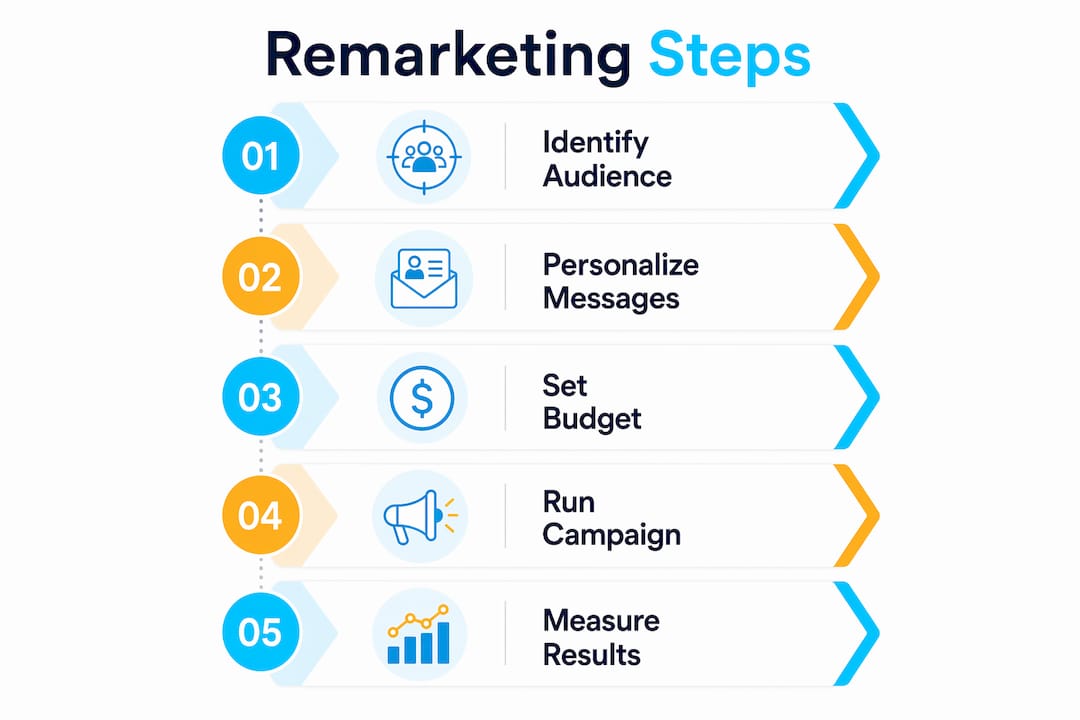
Here is how the mechanics work:
- Tracking pixels: You install a small piece of code (a pixel) from Google or Meta on your website. It records who visits and what they look at.
- Audience lists: The pixel builds lists automatically. You can segment by behavior: everyone who visited, people who started a reservation but quit, past customers who ordered 60+ days ago.
- Ad delivery: Once someone is on a list, they start seeing your ads across the Google Display Network, YouTube, Instagram, and Facebook as they browse elsewhere.
- Email automation: For customers who gave you their email, automated sequences trigger based on behavior. Abandoned booking? They get a reminder within 24 hours.
The most powerful move is message personalization. Someone who browsed your brunch menu gets an ad featuring your eggs Benedict and a weekend special. Someone who abandoned a private event inquiry gets a follow-up about your event packages. Generic ads waste money. Behavior-driven ads convert.
Pro Tip: Dynamic ads featuring specific menu items or limited-time offers perform best at the consideration stage, when a customer is hungry but hasn’t committed. Build at least one dynamic ad set for your top three menu categories.

Google remarketing ads reach previous visitors across millions of websites, apps, and YouTube. That broad reach means your brand stays visible long after someone leaves your site, which is exactly where the conversion happens.
How does restaurant remarketing compare to other strategies?
Not all restaurant advertising strategies are created equal. Search ads, social media ads, and loyalty programs each play a role. Remarketing is different because it targets warm leads, people who already know you exist.
Cold traffic ads (search ads targeting new customers, broad social campaigns) work hard to earn attention from strangers. Remarketing skips that step. The person already visited your site, scrolled your menu, or clicked your Instagram post. That prior interest makes them far more likely to convert. Retargeting ads often deliver 10x ROI compared to cold ads in restaurant marketing. That gap exists because you are not paying to educate a stranger. You are reminding someone who was already interested.
Here is how remarketing stacks up against other common restaurant digital marketing channels:
| Channel | Audience Type | Primary Goal | Relative Efficiency |
|---|---|---|---|
| Search Ads (Google) | Cold + warm traffic | New customer acquisition | Moderate (8.72% conversion rate) |
| Social Media Ads (broad) | Cold audience | Brand awareness, reach | Lower for direct conversions |
| Remarketing / Retargeting | Warm leads, past customers | Repeat visits, order recovery | Highest for retention |
| Email Marketing | Opted-in customers | Loyalty, promotions | High when list is segmented |
| Loyalty Programs | Active regulars | Retention, frequency | High for existing base |
A recommended restaurant advertising budget allocates about 20% specifically to remarketing campaigns. That 20% works harder than almost any other slice of your budget because it targets people already in your funnel. For a deeper breakdown of how to split your ad spend, the digital advertising guide from Ionhospitality walks through the full allocation model.
Remarketing does have limits. You need traffic first. If your website gets fewer than 100 visitors a month, your retargeting audience will be too small to run effective campaigns. That is why remarketing works best as part of a broader plan, not as your only strategy.
What are the best restaurant remarketing strategies?
Knowing what restaurant remarketing is matters less than knowing how to run it well. These are the tactics that actually move the needle.
-
Segment your lists by behavior and recency. Do not lump all website visitors into one audience. Abandoned bookings are your highest-intent audience and often convert with a simple reminder. Past customers who ordered 90+ days ago need a different message than someone who visited yesterday.
-
Use dynamic creative tied to what they viewed. If someone spent three minutes on your catering page, show them a catering ad. If they browsed your happy hour menu, hit them with a time-sensitive happy hour offer. Dynamic ads showing specific menu items or limited-time offers consistently outperform static creative for website visitors who did not convert.
-
Activate loyalty program messaging in retargeting ads. If you run a loyalty program, use retargeting to remind lapsed members of their unused points or rewards. This is one of the fastest ways to pull customers back without discounting.
-
Set up email automation for abandoned actions. A customer who started filling out your online reservation form and stopped is a hot lead. An automated email 2–4 hours later with a direct booking link recovers a real percentage of those lost reservations. Check out these email campaign examples that restaurants use to fill tables through follow-up sequences.
-
Drive direct orders, not third-party app orders. Delivery apps can take up to 30% commission on every order. Remarketing ads that link directly to your own ordering page cut that cost and build your customer data at the same time.
Pro Tip: Start with a budget of $10–$15 per day on Meta retargeting and $10–$15 per day on Google Display. Run for 30 days, then scale the channel with the lower cost per conversion. Do not try to run both at full scale before you know which one your audience responds to.
How do you measure restaurant remarketing results?
Running campaigns without tracking is burning money. These are the metrics that tell you whether your restaurant remarketing campaigns are working.
- Click-through rate (CTR): A low CTR means your creative or offer is not compelling enough. Test a new image or headline before increasing spend.
- Conversion rate: This is the percentage of ad clicks that result in a booking, order, or form submission. Restaurant search ads convert at about 8.72% as of 2024 benchmarks. Use that as a baseline for your remarketing campaigns, which should perform at or above that rate.
- Return on ad spend (ROAS): Divide revenue generated by ad spend. A ROAS of 3x or higher is a healthy target for restaurant retargeting.
- Frequency: How many times is the same person seeing your ad? Above 7–10 impressions per week, you risk ad fatigue. Cap your frequency in campaign settings.
- Cost per acquisition (CPA): What does it cost to get one new booking or order? Track this per channel so you know where to put more money.
Use Google Analytics 4 and Facebook Ads Manager together. Google Analytics shows you what happens after the click. Ads Manager shows you what happens before it. Together, they give you the full picture. A/B test your creatives every 3–4 weeks. Swap out images, test different offers (10% off vs. free dessert), and rotate headlines. The restaurant marketing strategies guide from Ionhospitality covers how to build a testing rhythm that does not overwhelm a small team.
Key takeaways
Restaurant remarketing delivers the highest return on ad spend when it targets segmented, warm audiences with behavior-driven creative across Google, Meta, and email.
| Point | Details |
|---|---|
| Define your audience first | Segment by behavior: website visitors, abandoned bookings, and lapsed customers each need different messages. |
| Allocate budget deliberately | Dedicate about 20% of your digital ad budget to remarketing for maximum retention efficiency. |
| Dynamic creative wins | Ads featuring specific menu items or offers tied to what a visitor viewed convert better than generic creative. |
| Track the right metrics | Monitor CTR, ROAS, and cost per acquisition weekly to know where to scale and where to cut. |
| Remarketing reduces commission costs | Driving direct orders through retargeting cuts third-party delivery fees of up to 30% per order. |
Why most restaurants are leaving money on the table
I have worked with restaurant owners who spend thousands every month on Instagram ads and Google search, then wonder why their tables are not full. The answer is almost always the same: they are chasing cold audiences while ignoring the warm ones already in their funnel.
Here is the uncomfortable truth. A person who visited your website, clicked through your menu, and then left is not gone. They are thinking about it. They are comparing you to the place down the street. A well-timed retargeting ad showing your best dish at the right moment wins that comparison. Without it, you paid to get their attention and then handed them to your competitor for free.
What I have seen work consistently is treating remarketing as an ongoing conversation, not a one-time campaign. The restaurants that win at retention are the ones running always-on retargeting alongside their seasonal pushes. They are not just advertising for Valentine’s Day or New Year’s Eve. They are quietly reminding past customers every week that they exist, that their food is worth coming back for, and that there is always something new to try.
The other thing most people get wrong: they set up one retargeting audience and call it done. The real leverage is in the segmentation. Your abandoned booking audience needs urgency. Your 90-day lapsed customer needs a reason to care again. Your loyalty member with unused points needs a nudge. Three different messages, three different results. That specificity is what separates restaurants that grow from ones that plateau.
— Doug
Ready to run remarketing that actually fills seats?
Understanding the strategy is step one. Executing it consistently, with the right creative, the right audiences, and the right budget split, is where most restaurant owners get stuck.
Ionhospitality specializes in social media advertising and retargeting campaigns built specifically for restaurants. We set up your pixel, build your audience segments, create scroll-stopping ad creative, and manage the campaigns so you can focus on running your restaurant. No commissions. No guesswork. Just more customers through the door and more direct orders in your pocket. Grab the free retargeting ads playbook to see exactly how we structure campaigns for restaurants like yours, or book a discovery call to talk through your specific goals.
FAQ
What is the difference between remarketing and retargeting?
Remarketing and retargeting describe the same core strategy: showing ads to people who previously interacted with your brand. Remarketing often refers specifically to email-based follow-ups, while retargeting refers to paid ads, but the terms are used interchangeably in most restaurant marketing contexts.
How much should a restaurant spend on remarketing?
A recommended restaurant digital ad budget allocates about 20% for remarketing campaigns. For a restaurant spending $1,000 per month on digital ads, that means roughly $200 dedicated to retargeting warm audiences.
Do i need a big website traffic volume to run remarketing?
You need a minimum audience size to run retargeting ads. Google and Meta both require at least 100–1,000 matched users before a campaign can serve. Focus on building traffic through organic content and search ads first, then layer in remarketing once your audience lists are large enough.
What platforms work best for restaurant retargeting?
Facebook and Instagram deliver strong results for visual, food-focused creative. Google remarketing ads reach previous visitors across millions of websites, apps, and YouTube, giving you broad visibility beyond social channels. Most restaurants benefit from running both simultaneously.
How long does it take to see results from restaurant remarketing?
Most restaurants see measurable results within 30–60 days of launching a properly segmented retargeting campaign. The key is having enough traffic to build audience lists quickly and testing creative within the first two weeks to identify what drives clicks and conversions.

Add a Comment