
TL;DR:
- Restaurant success now depends on owning a clear, specific brand position in customers’ minds.
- A strong positioning statement guides marketing, differentiates from competitors, and builds customer loyalty.
- Avoid generic claims; develop a bold, authentic identity that fills a market gap and resonates.
Great food and great service used to be enough. Not anymore. Today, restaurants that win are the ones that own a clear, specific space in their customers’ minds before those customers ever walk through the door. Brand positioning in hospitality means defining exactly who you are, who you serve, and why you are the only real choice for that person. Without it, even the best kitchen in town gets lost in the noise. In this guide, you will learn a practical framework for building a position that drives revenue, earns loyalty, and gives every marketing dollar a clear direction.
Table of Contents
- Understanding brand positioning in hospitality
- Competitive analysis: Mapping your unique advantage
- Crafting your positioning statement and restaurant identity
- Nuances, pitfalls, and bold examples in restaurant positioning
- Why clear positioning always comes before promotion
- Take your brand positioning further with expert support
- Frequently asked questions
Key Takeaways
| Point | Details |
|---|---|
| Clear positioning drives loyalty | Distinct brand positioning is critical for attracting repeat customers and commanding premium pricing. |
| Competitive analysis reveals gaps | SWOT and positioning maps help restaurant owners spot opportunities for unique differentiation. |
| Consistency builds trust | Applying your brand identity across menu, service, and digital touchpoints boosts customer confidence. |
| Boldness can mean revenue | Successful restaurants often embrace niche or daring concepts that set them apart and fuel rapid growth. |
Understanding brand positioning in hospitality
Let’s clear something up fast. Brand positioning is not your logo, your color palette, or even your menu. It is the perception your restaurant creates in a customer’s mind the moment they hear your name. That perception is either built intentionally by you, or accidentally by the market. You want to be in control of it.
Here is what strong positioning is built on:
- Audience targeting: Who is your ideal guest? Be specific. “Everyone who loves food” is not an audience.
- Differentiation: What makes your experience genuinely different? Think cuisine style, sourcing story, atmosphere, or cultural identity.
- Clear positioning statement: A single sentence that captures your unique value and guides every decision you make.
A positioning statement defines your unique space in customers’ minds. It is not a tagline. It is an internal compass. Use this fill-in-the-blank framework to build yours:
“For [audience] who [need], [your restaurant] is the [category] that [benefit] because [reason].”
Here is why “great food and service” fails as a position. Every restaurant claims it. It is expected, not differentiating. Customers cannot use it to decide whether your place is right for them. It gives them nothing to remember, nothing to share, and nothing to feel loyal to.
Your restaurant branding guide should flow directly from your positioning statement. Everything, from your menu language to your Instagram captions, should reflect that one core idea. If you want to build brand awareness that actually sticks, positioning is where it starts.
Pro Tip: Write your positioning statement before you design anything or post anything. Pin it above your desk. Every marketing decision should pass through that filter first.
Competitive analysis: Mapping your unique advantage
Understanding your brand is just the first step. The next is mapping your position relative to competitors. You cannot find your unique advantage if you do not know what everyone else is already claiming.
Competitive analysis uses SWOT and positioning maps to identify market gaps. Here is how to run one for your restaurant in four steps:
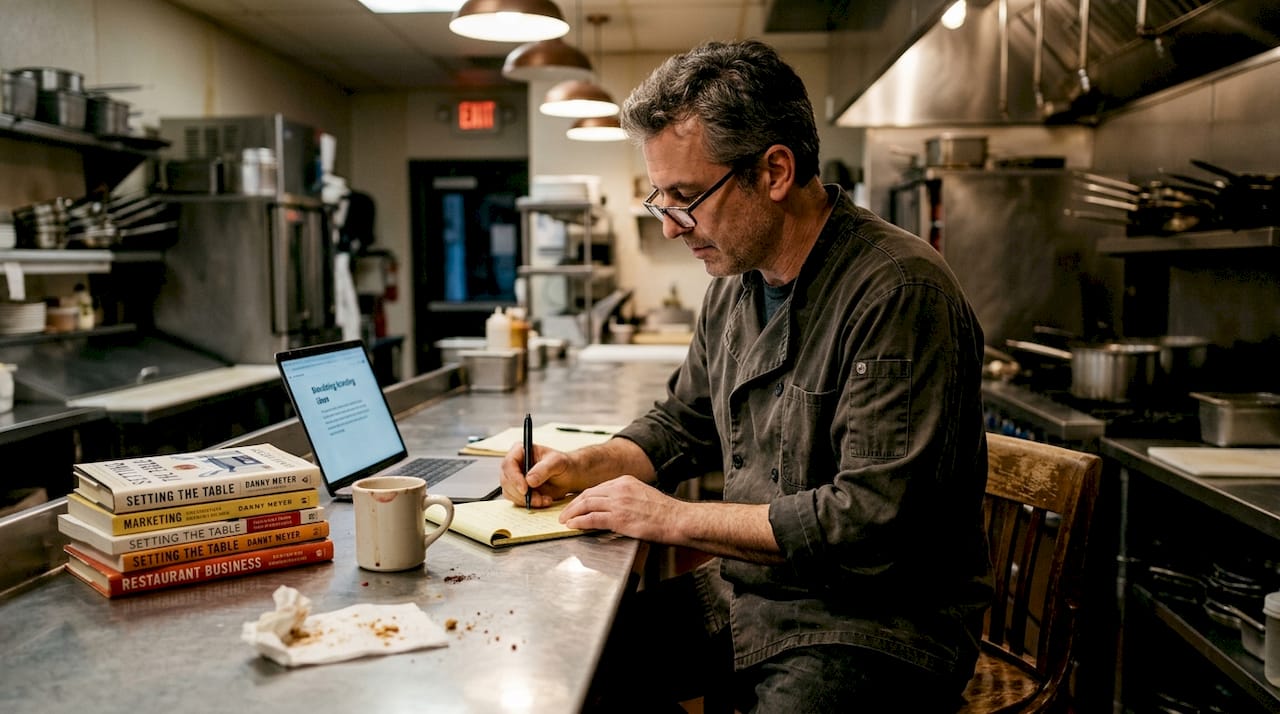
- List your top 5 local competitors. Include both direct competitors (same cuisine, same price range) and indirect ones (fast casual spots stealing your lunch crowd).
- Run a SWOT for each one. Strengths, weaknesses, opportunities, threats. Be honest and specific.
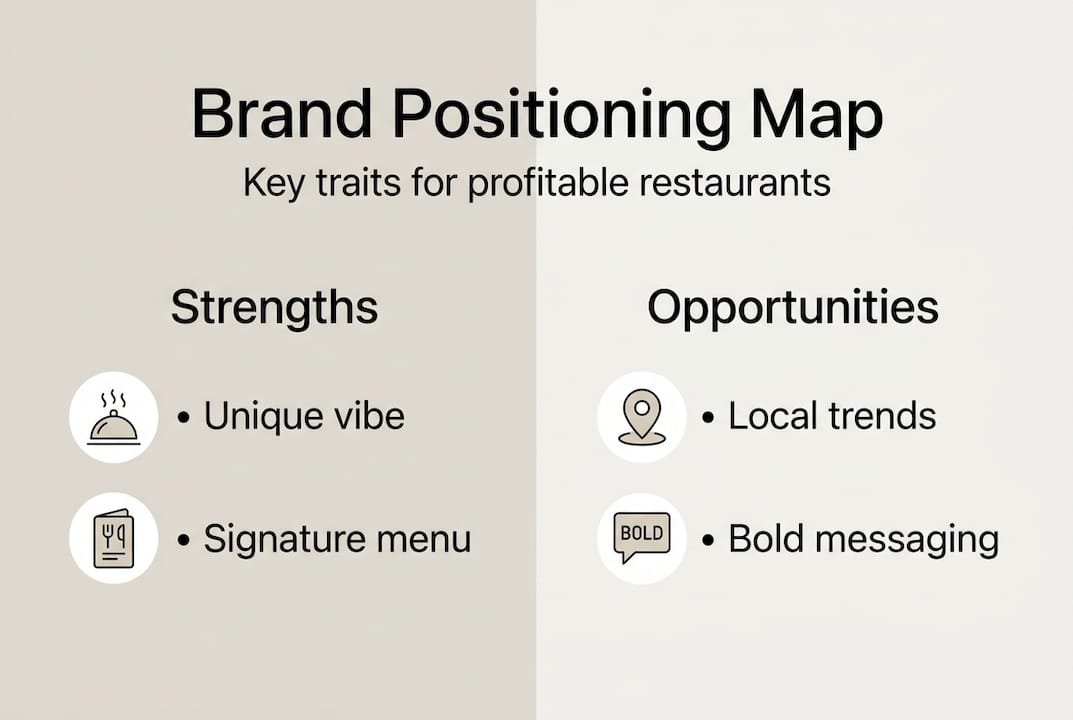
- Build a positioning map. Plot competitors on a two-axis chart. Common axes: price vs. quality, casual vs. upscale, traditional vs. innovative.
- Spot the white space. Where is there a gap no one is filling? That gap is your opportunity.
Here is a sample comparison to illustrate the process:
| Factor | Competitor A | Competitor B | Your restaurant |
|---|---|---|---|
| Price point | Mid-range | Budget | Mid-range |
| Atmosphere | Casual | Fast casual | Upscale casual |
| Differentiator | Big portions | Speed | Local sourcing |
| Social presence | Strong | Weak | Growing |
| Customer reviews | 4.1 stars | 3.8 stars | 4.6 stars |
Once you see the landscape clearly, your branding steps become much more focused. You are not just building a brand. You are building a brand that fills a specific, uncontested space.
Pro Tip: Do not just look at menus and prices. Dig into your competitors’ social media, Google reviews, and website copy. That is where their real positioning (or lack of it) shows up.
Crafting your positioning statement and restaurant identity
Once you identify your competitive edge, it is time to articulate your position and build an identity customers recognize. This is where strategy becomes story.
Follow these steps to write a positioning statement that actually works:
- Define your audience. Not just demographics. Think about mindset, values, and what they want to feel when they dine.
- Name the need. What problem or desire does your restaurant solve for them?
- Pick your category. Are you a neighborhood bistro, a celebration destination, a fast-casual health spot?
- State your benefit. What do guests get from you that they cannot get anywhere else?
- Back it with a reason. Why should they believe you? A 20-year family recipe, a certified organic kitchen, a chef with a James Beard nomination.
Here is how bold positioning translates to real-world impact:
| Restaurant | Positioning angle | Outcome |
|---|---|---|
| Slutty Vegan | Bold, fun, plant-based personality | $4M revenue in first 6 months |
| Prime Rib (rebranded) | Heritage steakhouse, old-school luxury | Renewed premium pricing power |
| Sweetgreen | Health-forward, transparent sourcing | National scale with loyal base |
Positioning drives clarity and premium pricing. But it only works when it is consistent across every touchpoint.
Here are brand personality traits to consider when shaping your identity:
- Warm and welcoming vs. sleek and exclusive
- Playful and bold vs. refined and classic
- Community-rooted vs. globally inspired
- Transparent and mission-driven vs. indulgent and escapist
Your content creation strategy should mirror these traits in every post, every caption, and every video.
Pro Tip: Walk through your own restaurant like a first-time guest. Does every element, from the menu font to the music to the server’s greeting, reflect your positioning? If anything feels off, that is a gap to fix.
Nuances, pitfalls, and bold examples in restaurant positioning
With your brand identity in place, understanding expert pitfalls and learning from standout examples adds even greater clarity. Because even a well-crafted position can fall apart in execution.
The biggest mistake: Generic claims. Saying you offer “quality ingredients” or “exceptional service” tells customers nothing. Every restaurant says that. Bold positioning requires a specific, ownable claim. Something that makes people nod and say, “Yes, that is exactly for me.”
Here are contrasting positioning personalities to spark your thinking:
- Heritage and tradition vs. daring and experimental
- Neighborhood staple vs. destination experience
- Comfort-driven vs. status-driven
- Hyper-local vs. globally influenced
Portfolio dilution is a real risk when you expand or rebrand. Adding too many concepts, menus, or messages under one roof blurs your identity. Customers get confused. Confused customers do not become loyal customers. Protect your core position fiercely, even as you grow.
Balancing innovation with authenticity is another tension point. Guests want new experiences, but they also want to trust that you are still the place they fell in love with. Hospitality innovation trends show that technology and novelty can enhance positioning, but only when they reinforce your core identity rather than replace it.
Slutty Vegan built a $4M revenue stream in its first six months not through massive ad spend, but through bold, simple positioning and a personality customers wanted to be part of.
The data backs this up. Perceived innovativeness predicts willingness to pay a premium among upscale diners. When guests see you as forward-thinking and distinct, they justify spending more. That is the direct link between positioning and revenue.
If you want to attract new customers and keep them coming back, your position needs to be bold enough to cut through. Pair it with crowd marketing and proven social media campaigns and you have a full engine for growth.
Why clear positioning always comes before promotion
Here is our honest take after working with restaurant owners across the country. Most owners jump straight to advertising. They boost posts, run ads, and wonder why the results feel flat. The problem is almost never the ad. It is the absence of a clear position underneath it.
Promotion amplifies what already exists. If what exists is vague, promotion just spreads the vagueness faster and wider. Positioning before promotion gives customers a reason to care and drives long-term loyalty.
When you get positioning right first, every ad, every reel, every email has a clear job to do. It reinforces a specific idea in a specific person’s mind. That repetition builds trust. Trust builds loyalty. Loyalty builds revenue that does not depend on discounts or constant ad spend.
The restaurants we see winning right now are not the ones with the biggest budgets. They are the ones with the clearest story. Invest in your hospitality marketing strategies only after you know exactly what story you are telling.
Take your brand positioning further with expert support
You now have the framework. You know how to define your audience, map your competition, write your positioning statement, and build an identity that earns loyalty and premium pricing. The next step is putting it all into motion.
At ION Hospitality, we help restaurant owners turn positioning strategy into real results, more customers through the door, more private events booked, and more online orders flowing in, all with zero commissions. Whether you need to build restaurant brand awareness, launch social media campaigns for growth, or build a website that converts, we do it all for you. Let’s build something people talk about. 🚀
Frequently asked questions
What is a restaurant positioning statement?
A restaurant positioning statement is a one-sentence promise that defines your unique value and target audience, guiding every marketing and operational decision you make.
How does a SWOT analysis help restaurants improve brand positioning?
SWOT analysis surfaces your strengths, weaknesses, opportunities, and threats so you can identify market gaps and carve out a more distinct, defensible position.
What are common pitfalls to avoid in restaurant positioning?
The biggest traps are generic claims, inconsistent messaging across touchpoints, and portfolio dilution when expanding, all of which blur your identity and erode customer trust.
Can bold, niche positioning really impact revenue?
Absolutely. Slutty Vegan’s $4M in six months proves that a clear, bold personality drives revenue faster than a big ad budget ever will.

Add a Comment